Showing posts with label Africa. Show all posts

Tuesday, August 4, 2020

where is the hope


A few days ago, I messaged one of my nurse friends. “I think I can be creative with Mary’s bandages until the next crate arrives… as long as no one else gets burned.” Today, a little girl whose pants caught on fire showed up at my door. It’s when your ‘just enough’ turns out to be too little that hope comes hard. 


My friends who thought they just had to get through the summer are feeling this too. ‘Just enough sanity’ to survive till school starts has been hijacked by school not reopening, and I see a familiar hopeless look in your eyes. 


As I lifted the little girl into my tub, giving her Tylenol and cookies to distract her from what was about to happen, I sized up the damage. Thirty percent of the upper thigh, not over any joints. “The clinic sent you home to care for it yourself, didn’t they?” I asked, judging by the gooped on toothpaste and ashes that are considered “traditional medicine” for burns. 


Back home my friends are cleaning up different messes. The protest fires of injustice and racism and hate are blazing in Portland and elsewhere and the “traditional medicine” of white supremacy doesn’t debride without tears either.


Where is the hope?


The little girl started crying as I slowly rubbed away the crust that was clinging angry to the tender flesh. Not recognizing either the girl or her mom by face, I asked where they live. M’wanguni, the mom said, in between telling her daughter to not cry so loud. “That’s two villages over,” I observed, “How did you know to come here?” “I heard from the man whose finger you fixed that you were kind to people like us,” she explained. Ah yes. The man who presented me with a severed finger that the clinic wouldn’t touch except to cover with a square of gauze tied on with a condom. 


It’s never ending, the wounding is. For me or you. Breonna Taylor’s murderer still walks free; the poor are being pushed farther out of affordable housing; and demon sperm lady is practically surgeon general.


Where is the hope? 


There was a time when scenes like this would have wrecked me. More times than I can count, I’ve left a bleeding person alone in my bathroom so I could go outside and sob heavy. And while I’m holding tight to wound supplies and not BLM signs, I feel your pain too – I do. That I can’t march with you, that I can’t help teach your kids’ pod, that I can’t hand you Tylenol and cookies while we tackle this life together – it grieves me in its own way. 


Where is the hope?


I want to be optimistic; that the Tylenol will take the edge off, that tomorrow the pink skin will magically be brown, that medical neglect will no longer send people to my door. I want to be optimistic for you too; that the Covid curve will angle down and that black communities will be lifted up and that music will return to your streets. 


I love the optimists in my life, and I aspire to be one of them. Deeply connected to heart’s desires, goal oriented and stubbornly positive. Optimism motivates us to take risk and study burns and speak truth to power. Optimism serves us well… until it doesn’t. When the next patient is more critical than the last and the next tweet more heinous than the first it’s a sucker punch to the gut and all those Pollyanna thoughts feel childish. Confrontation with reality has sent more than a few optimists into rehab where we’ve tried to make sense of how we could have been so naïve. 


Where is the hope?


Wiser, more experienced, we get our act together. I order hundreds, not dozens of bandages at a time and silver sulfa now by the gallon. You round up screen shots for facebook ammo and amplify black voices as we try and figure out how to realistically achieve this thing we call healing.


But our expectations are tempered more than we admit. Where we no longer pray for miraculous healing and justice is only preached to the choir. Those brave desires have been swapped out for a safer, more cynical version… but at least we’re being realistic, and that feels grounding… though depressing in its own way. 


Where is the hope? 


Not knowing how to show up for myself, or you, or anyone, I show up to therapy and try to figure out where I am. I learn that the place I find myself is squarely in-between. I learn that God gave us two hands for a reason, so that we might remain deeply connected to our optimistic dreams while also deeply connected to the world’s brokenness. In the space between, wanting so much, and seeing so little, we feel the tension in every cell of our bodies, which opens the possibility of discovering that this is where hope is. 


When healed patients feel loved through hours of connection, I find meaning in the pain. Now  I’m hopeful, instead of devastated, by each new story that reaches my door. As I’m watching America from afar, seeing the end of conservative evangelicalism and the emergence of fresh faith, I feel hope for you in so many ways too. Hope lives in the already and the not yet – where we believe that change is possible while still sensing how broken we are. Where the light shines bright and yet darkness still permeates. Where heaven has come and yet is not fully here. This is where hope is.


Lament puts words to the insanity of it all. With space for both the longing and doubt that makes us human: That what we experience is awful, but not beyond redemption. That I’m powerless to fix it but I’m empowered by the one who can. That the-God-who-sees is made of everything I am not. That evil is pervasive but there’s more grace than I know. Lament roots us in hope by declaring that suffering is real, but mercy is near, and if everything we long for falls apart, the shattered dreams will, in faith, become the building blocks of a surprising tomorrow. This is where hope is.   


And by sowing tears and reaping joy we carry on, hoping against hope that we won’t be disappointed. As I optimistically wrap wounds and realistically still dispense the analgesics. As you optimistically cast your ballots and realistically pray in closets. We can go to task and then go to sleep because the results are not ours to manufacture. It’s in the space between optimism and reality that hope thrives because that’s where God is, involved in what is, working out what will be, and actively transforming everything in the process. And for this reason, and this reason alone, it will be ok. 


Hold on to hope, my friends. Let’s hold on to hope. 


Tuesday, June 9, 2020

raising girls amongst karens

Recently, one of my friends of a different race and generation posted a question on social media asking, “What’s a Karen?” He received good responses, mostly copied and pasted from google. I think the tidiest definition for me was:

A Karen is a white woman who feels entitled enough to weaponize her skin color particularly against black men.  

Yup.

Feeling cheeky, I added my own definition, writing, “my face, less woke.” 
Seeing my extra pale skin in the little photo next to the comment I sighed – it’s sad, but true. 

Despite knowing several perfectly wonderful women named Karen, the stereotyped “Karen” as a racist icon has become the meme du jour. They are the wives of Chad, the mothers of Brad and the best friend to Brenda and Becky. All of these people are dangerous but Karen is basically the matriarch of the pro-white movement, so I don’t mind letting her take the fall for the whole lot. 


I was born of white women. Raised by white women. Surrounded almost exclusively by white women. Some turned out to be Karens, others not. Now, having lived a third of my life in Africa, where the white women I interact with are actually one in a million, Karen has its own meaning for me. Here, Karen isn’t going to call 911 for feeling threatened by a black man in a hoodie, but colonialist Karen and white-savior Karen have their own ways of oozing superiority. All that to say, my minority status here doesn’t give me a pass. There’s not a single white woman on the planet who doesn’t need to do business with her inner Karen. Such is the world we live in, and the world we are raising our daughters in too. 

When our first two children came out female and blonde headed, our circle of anti-colonialist, anti-racist, anti-Karen work expanded. “Privilege” in the village takes on specific form, so we started with the basics: you’re not as special as people think you are. We taught them that when they are given free stuff in stores, they don’t deserve it and it must be shared equally with their friends. When an adult takes something out of their child’s hand to give it to the white girls, our kids are obligated to hand it back to the original child. When an adult is displaced in order to put their white butt in a seat, the girls must decline and sit on the floor. These are some of the house rules on par with “chew with your mouth closed” and “say please and thank you.” 


They aren’t perfect. We still have to interrupt their play time to coach them towards kindness. Nine times out of ten they don’t even realize what’s happening when others defer to them. I don’t think your friend is feeling loved, we reflect out loud. Oh, they say, and make a change. The relationship practice gives meaning to the rules. Our goal is to instill habits and attitudes that will support healthy relationships for the long haul. If the rules don’t play out on the playground, they won’t play out in adulthood. There are plenty of right thinking, poorly behaving adults in America right now who know the good they ought to do and are not doing it because theory never became practice. The exercise of relationship hasn’t taken place. 


This is the essence of the Karens who are championing All Lives Matter. They are operating out of a philosophical framework in which “liberty and justice for all” is scrawled across the placards of their lives but for some reason, saying Black Lives Matter strikes a chord. Why? My observation, as I hear their arguments on social media, is that their response is entirely cerebral. I’m not hearing any empathy or connection, and as proof of the absence of relationship bubbles to the top like sulfur, I think about my own girls again.

A few months ago, we were reading for homeschool about Vasco de Gama’s voyages around the horn of Africa during which the slave trade expanded greatly. As I read about Africans being tied up and shipped off as slaves, I could feel the wave of emotion rising in my 8-year-old sitting next to me. As I read on, her gaze lowered, and her brow furrowed. Her fists clenched and she stiffened her whole body until she cut me off with a guttural roar. I stopped reading, knowing that my girl and her big feels was going to need a moment to work through this one. I know her heart and had seen it coming. She sputtered for a moment, the rage flooding faster than her brain could find words for and finally she screamed at de Gama and his crew, “THAT WAS TIMO!!!” (her best friend) “Those are my people! Those are my friends!” And her face fell into her hands and her body flopped on my lap and we sobbed together for a long, long time.

Day to day life for our very white daughters involves constant interaction with people who do not look like them. Their friends are exclusively black. The people they admire are exclusively black. The sources of their greatest joys and most favorite memories are all black. While America is at war with itself over its ingrained fear of black men, our two little white girls are absolutely enamored with a whole community of black men who are not only trusted, but also adored. Through repeated exposure, their brains have been wired to perceive black men as protectors and not threats. So while Karen is calling the police because she’s six feet away from a black man minding his own business, our girls are running straight into the arms of black men whom they love. The idea of black people – their friends – being mistreated is intolerable. And it’s not because our girls are better people, or we’re better parents – it’s simply because they’ve had the right kinds of experience. 


That day, as we read about the start of the slave trade, my daughter got her first taste of dehumanization. By entering into the gallows of the slave ship, she felt helpless and betrayed by her own skinfolk, overwhelmed by 500 years of evil that she couldn’t undo and didn’t know how to make right. I wasn’t going to talk her out of her grief. I’m glad she felt it. The ability to lament deeply the wrongs of people who look like us is a necessary part of growing up un-Karen. 

I’ve been watching the dumpster fire of social media interaction the last few weeks as black folks are BEGGING to be heard and white America is doing a barely mediocre job of listening. The BLM allies are growing increasingly frustrated because they are working overtime in the education department – trying to drop knowledge on every single Karen who is crying taupe tears because her soul is wounded by the idea that anyone else’s life should matter too. I see it. The precious few woke white women are on the verge of hysterics wondering why Karen just doesn’t get it. And of course, Brad, Chad, Brenda and Becky are showing up to add their piece too and the air smells rancid like white supremacy. The riots are visible symbols of invisible pain and moment by moment it's ambiguous whether this is moving forward or backward. 


But none of this should be surprising. Ultimately, America needs to experience healing, and that will never happen if people are not in relationship. What separates the Karens from the people trying to rein them in is that the white people who “get it” all have significant relationships within the black community. 

I’m not talking about “token black friends,” I mean these bridge builders are IN COMMUNITY with people who don’t look like them. They spend considerable time in each other’s homes. Their children are best friends. They share values and a vision for their neighborhood. They break bread. They like each other. They love each other. And the depth of the relational bond is significant enough that when one hurts, the other hurts. Of course their black friends’ lives matter. And it is for these white folks that “dismantling systemic racism” is not an intellectual exercise – it's personal. 


Right now, I’m seeing a lot of resources circling about books to read and conversations to have and that’s awesome, but it isn’t relational enough. Studying black history is essential, but distantly academic. Karens aren’t dumb, they are disconnected – from black pain, from the consequences of their privilege, from reality. I’m pretty sure Karens have google. What they don’t have are black friends. Even if it’s in their heads, it’s not in their hearts, and it’s not in their hearts, because it’s not in their homes. The bridge between knowledge and action is the motivation to care, and that only comes from meaningful relationship. 


Last night Bronwyn was curled up on the couch reading the children’s book Beatrice’s Goat about a little girl in Africa whose family receives a goat from an NGO. Reaching the end, she hopped off the couch and said, “Hey, it says Beatrice lives in a small African village! Do you know where we can find a small African village?” Jeremy and I just looked at each other, and then at her and we both laughed, “Bronwyn, you literally live in a small African village. We literally run a program to manage livestock for 300 families just like Beatrice…” And she just looked at us and was like, Oh. I guess you’re right! Despite the fact that this book was describing the backdrop of her life, it was a story to her and therefore looked new and unfamiliar. Beatrice’s life wasn’t something she was living, it was something she was reading. Text is… textual. But her friends whom she throws her arms around and feels in the flesh – that’s what’s real. 


Children need black hands to shake and hi-five and hold. They need black friends, black teachers, black doctors, and black pastors to admire. Our black son needs to see faces who look like him and our white girls need to see faces who don’t. The key to breaking the Karen cycle is to provide our girls with repeated experiences of sustained, positive interaction with black people – in particular black men – over the course of their growing up years. I don’t believe there is any substitute for this.


I can hear Karen’s brain processing: Not all of us live in Africa, Bethany. Finding this in the middle of Whitesville, USA is hard. There aren’t many black people here.

Good observation Karen! Fostering meaningful relationships might mean changing schools, or changing churches, changing doctor’s offices or neighborhoods or even towns. 

We know families who have uprooted themselves in search of diversity, and I applaud them for that. It may sound radical, but I wouldn’t even be throwing it out for consideration if I wasn’t 110% convinced that it’s worth it. Racial reconciliation requires relationship. Full stop. 

I appreciate that not every family is in a position to actually MOVE, so it does beg the question, how far should the pursuit of racial diversity go? That’s up to you – how much do you want your heart to grow?

Our family would be willing to go pretty darn far. Because we know from experience that it’s not a sacrifice. It’s a gift. To us, and to the Karens who need someone to bear witness to uncommon love.  


Monday, March 2, 2020

how to grieve: an African primer


I lost my fourth and final grandparent last week. This is the third family death since I’ve lived abroad, and I haven’t been able to return home for any of them. I’m ok with it, in a resigned way – death is a part of life, and missing out on major family events is an expected consequence of working overseas. It has gotten me thinking though.

You know, we’ve attended maybe 100 or more funerals in our time here. With a life expectancy in the 40s and an environment that is constantly prowling for its next victim, death literally comes with the territory. While there are many cultural things that we haven’t gotten used to – such as eating chicken feet or not looking people in the eyes – grieving in the style of our neighbors is different. We are more than used to it – it has become our way of grieving too. It just feels right.

I remember one of my earliest conversations here, as someone asked me about grief and mourning and funerals in the United States. I explained that usually a service would be scheduled and people would attend, and that close relatives would check in on the bereaved afterwards, and others might bring a meal, but that mostly people preferred to mourn privately. My neighbor looked at me with so much concern as if I had told her that Americans grieve by snorting crack and she just said, “Oh Bethany, that’s not healthy.”

I had no idea what she meant by that, but now, with what feels like a century’s worth of funerals under my hat, I appreciate where she was coming from, and I agree with her. Americans mourn the way they do for cultural reasons, not because a band of emotionally intelligent people came together and said, this is what is best for our hearts. The way grief is handled in our community just feels healthy and I wish that all of my friends could experience it the way I have. 

Most recently I attended the funeral of a young boy who died after the clinic refused to call an ambulance. I’ve written about the local ambulance situation before, and again, this death affected me deeply. For many reasons – it’s not our responsibility, we are busy right now, we’ve already gone to town five times this week ­– I declined to take the child to the hospital myself, and when he died, the weight of that decision absolutely crushed my heart. I knew that I needed to be present at that funeral and took myself there immediately. 

Funerals start the moment a person dies and I arrived to find the bulk of the village already gathered, as was expected. In village life, whether you are intimately acquainted with the deceased or only knew him as that kid down the road, funerals are whole community events. The commitment to mourn together reflects the belief that mourning is not only important but also that we need each other to do it well. 

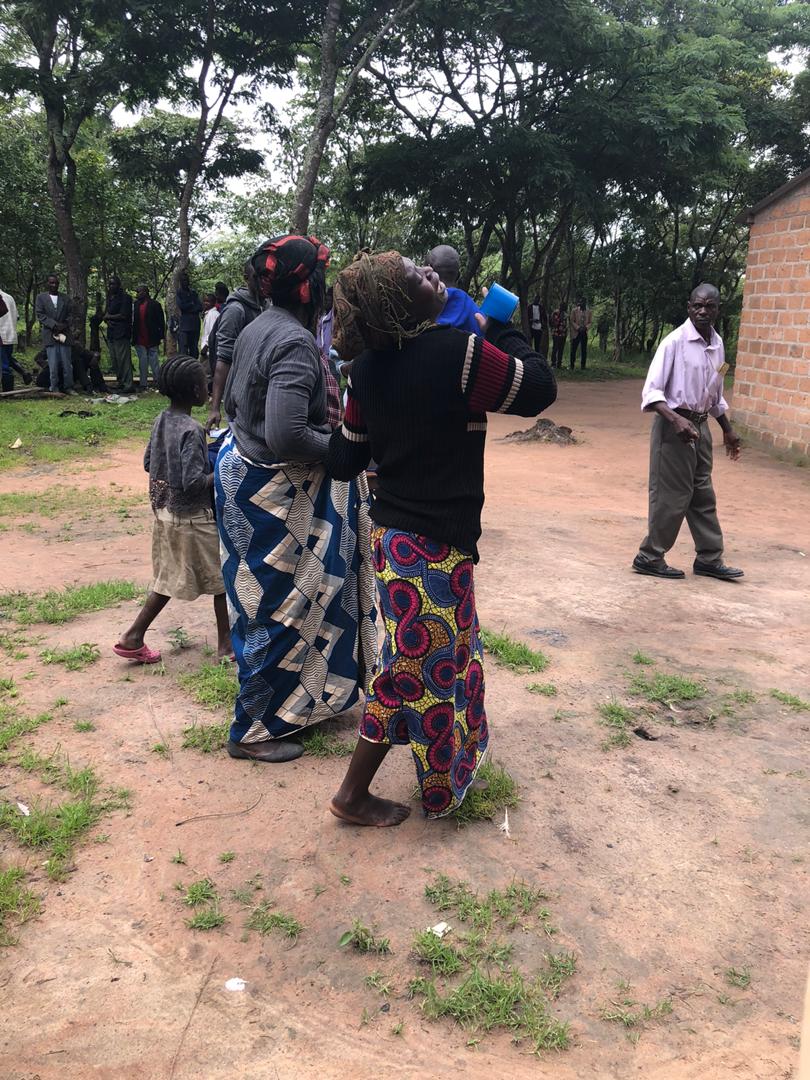
I entered the funeral house which had already been emptied of furniture to accommodate the masses who would be moving in. The body of the child whose soul was no longer with us was laying in the corner, a woman next to him swatting flies from his face. The mourners had already begun their work of shedding raw and restless tears and I received gladly the permission to begin releasing my own. I beelined it to the mother and kneeling, draped myself over her. Instinctually, I clutched her thin body, her head immediately resting heavy on my shoulder. As her sobs grew louder, I just bellowed over her, “I’m sorry mama, I’m so sorry I didn’t take him, I’m so sorry.” I leaned into the catharsis of confession. My body heaved with each “I’m sorry” and hers did too. We held that posture until the tears slowed and the wails softened and I could feel the tension in both her body and mine relax a little. I let her go and sat back on my feet. She began telling me the story of how her son had been fine and then all of a sudden he wasn’t. She told me it wasn’t my fault and I undeservedly received that grace. We shifted ourselves to lean against the hut wall, gladly letting it bear some weight for us as we settled in for the emotional marathon ahead. 

I scanned the room and looked into familiar faces. Their tear stained cheeks were evidence that they had already completed round one of wailing and were giving each other reprieve before starting again. I respect these women so much for their service – I know they attend far more funerals per year than I do, and their tears accomplish so much. They have mastered the art of facilitating the grieving process – a sort of spiritual midwifery whereby the bereaved may come to access, feel and release every single emotion there is. Emotions must be felt in order to be processed and grief must be experienced in order to be healed. Emotional grief is a full body, sensory event – not something contained in dainty little tear drops. 

After a short while, the mourners began again, first with a quiet cry, and then a crescendo of anguish. Fists pounded the floor. The boy’s mother flung herself across my lap and I began stroking her hair and massaging the small of her back while my tears made a growing wet spot on her shirt. When someone in the room found words, they were yelled heavenward, without filter or judgement: Why God! Why did you take him! We weren’t done with him yet! He didn’t even go to school! Who will take care of me when I am old? I can’t go on! I wish I could die too!


In good wisdom, as great midwives, the mourners worked through pain-filled waves one at a time. Crying and screaming carried on until exhaustion took its turn. When bodies needed a break, we sat quietly or just talked. When eyes were heavy, there was no sacrilege in sleep. But the work of the mourners was always to bring us back to the task at hand – feeling the emotion and setting it free. As such, someone would just sense it – that the rest period had been enough – and that the tears needed to start again, and they would release a mournful wail that called forth what was left inside, awaiting its turn. 

While this funeral was deeply personal to me, I have learned through many other experiences that it doesn’t matter whether the deceased was your best friend or someone you only saw once on the street; when others start crying, you will start crying too. Thanks to healthy mirror neurons, our brains are wired to reflect the pain of one sitting in front of us, and as we do, we share the collective weight of it. The implications of this are profound. In short, we need to mourn with other people so that our brain and body can find the emotional relief we need.

I stayed for a few hours and left knowing that the rest of the group (less concerned than I of sleeping without a mosquito net) would stay all night and into the next day and the next. Our friends are never in a hurry, and particularly when it comes to mourning. They know from lived experience that there is no shortcut to grief. There is no fast-track, and trying to speed up the mourning process – or heaven forbid, cut it short – doesn’t actually hurry healing, it only shifts it to a later, lonelier date. 

I had gone to the funeral house feeling sad and shattered, and I went home still sad, but honestly more whole. This is the gift of riding the undulations of grief until the physical body feels differently. This process is so different from what I grew up with which can be described as emotional “management,” something I see now in such a different light. I think we as westerners cause ourselves so much unnecessary pain by putting ourselves through the actual torture of trying to suppress unwanted emotions instead of simply feeling them. We equate short grief and fast healing with resilience, but truly there is no greater resilience than sticking with the hard task of mourning until it is fully done. The clock does not tell us how to heal.


Before getting in my vehicle, I sought out some of the key the organizers. The men outside were well practiced at taking care of a funeral's logistical needs. The strong, 20-somethings had dug the hole. Others were finding a carpenter and arranging a coffin. I connected with the ones soliciting funds to purchase food and firewood and made my contribution. This mobilization is not the family’s job. Their job is to mourn. It’s the community’s job to provide the care.  

My heart grows three sizes bigger every time I see this kind of togetherness. The safety and compassion and care – it reminds those of us who are privileged to participate that we are wired for struggle and worthy of love and belonging.  I can’t imagine tapping into that comforting truth if I were expected to mourn alone at home or awkwardly in a front row pew while shedding only a few acceptable tears. I just can’t. Not now anyway. Not now that I’ve felt how therapeutic it is to sob and to blow snot into the very chitenge that I am wearing and to feel how feeling-the-feels makes it feel better.


For weeks after, I would see a member of that family and say the thing we all know to say in the wake of a loss. We say, “Mwaculeni” (mwah-choo-lay-nee) which simply means, “You are mourning well.” Note that no one asks, “how’s it going?” as if the mourner should submit a progress report or even be able to articulate the mystery of healing. Just, Mwaculeni: the acknowledgement that you are mourning well – whatever that looks like – whether the tears have dried up or still falling freely. There is a permission granted with that blanket affirmation that that has its own healing effect. To hear the words, “You are doing what you need to do, and you’re doing it well,” might be the kindest thing we could speak to a hurting heart. 

I know my family will gather later this week for a funeral. I don’t know whether they will truly grieve or just have a service. I hope they do both, though I doubt that any women will come into the church and flail themselves onto my mother and aunts and uncles and commence wailing… but I wish they would. For all who mourn, now and in the future, just know that I will always hold (a very African) space for you. 

Saturday, November 16, 2019

re-framing the adoption narrative

She came to us on a Saturday night, after lying alone in a room for nearly 48 hours. We hadn’t planned for her. In fact, earlier that morning, I stood together with Jeremy in the storage shed while we debated getting rid of all the clothes our youngest had outgrown. 

We’re done, right? 

Uhhh… I think so???

…

Let’s just hang on to them a little longer, ok?

Ok. 

And an hour later, Bana K was at our door explaining what happened. 

Mom had been on the way to the clinic when baby M came. Somewhere between home and safety, she birthed, bled and died. A neighbor pulled them both into a hut and the funeral began. Baby M was wrapped in a blanket and placed in a back room. With no one to nurse her, the family prepared for not one, but two burials. 

Something in her cries that night must have pushed the family to think differently. Several of the funeral attendees knew us, and a messenger was dispatched. I arrived to find Dad, his seven other children, and the 200 or so mourners typically found at a village funeral. I was ushered into a two room house. The four-year-old on the other side of the brick wall was wailing for his mom who wasn’t coming back. The family sat with me on the dirt floor while other curious bodies crammed in, blocking what little light would have come through the door and triangle windows built into the exterior walls. Dad leaned on the wall across from me, no longer coping with the two-year-old fussing on his lap. The fifteen-year-old next to him was little help. They both looked like they'd been run over by a truck. 

The family asked me to speak, and I asked first to just listen. In turn, old women said the same thing, one after another. “We need help. We can’t manage. Please help us. Please help.” I said, “I want to help. She needs to eat. It has been too long. I can have milk here in a few hours.” 

They had already decided though what kind of help they were looking for. 

“Take her.”

“Uhhh…”

“We just can’t right now. We’re not managing with the other seven. We need you to take her.” 

There we sat, between a rock and a hard place. A shell-shocked family desperately asking for help. Me, rolling over attachment theory in my head. Above the clamor expressing this challenge and that, I blurted out, “She needs her family!” And they upped the volume a notch and yelled back, “We need YOU.” And ten minutes later, someone was shoving into my vehicle a bundle of blankets, at the center of which was a darling little girl. 


Every year when Adoption Awareness Month (November, fyi) rolls around, I get this sinking feeling in my gut as I see the internet filled with stories and pictures of happy adoptive families who would center the narrative around the beauty of adoption. And truly, adoption is beautiful. To choose to love is beauty incarnate. But, truly-truly, it is beauty from ashes. We owe it to the adoptees in our midst to acknowledge that ashes are a bi-product of something being burnt to the ground. 

There is no other way to arrive at adoption other than extreme trauma and loss. A mother dies. A family breaks. Addiction. Disfunction. Abandonment. We can’t manage - take her.

Sometimes I feel like we are so busy celebrating the redemption that we hold precious little space for the tragic. It is both lovely and awful at the same time. Like my favorite Ann says, “Joy and pain are arteries of the same heart,” and intentional orphan care means we handle both well. 

It might seem unreasonably pessimistic to even suggest re-directing the conversation towards trauma. Who doesn’t love a happy ending? What’s wrong with you, Emo Adoption Lady? 

What’s wrong with me is that I grew up in the first world and have lived my entire adult life in the third, and now as a foster and adoptive mother, I see the trajectory of orphan care from two different continental views, and I’m still unsettled. 

In America, we have focused on keeping children safe, and with family when possible, which means we major on two actions: removal and reunification. “The system” is swamped and foster parents, bless them, are doing their best. In Zambia - to our shame - we have largely focused on crisis management which has meant institutionalization. As I’ve written about before (here and here,) the funding flow out of the West fuels the glorification of orphanages and the result is thousands of children in “care” (a misnomer) while their DNA is out there. 

What has my gut twisted in knots and wrapped around my heart is that, on either continent, in any context, when I hear talk about adoption awareness, the thing that I’m NOT hearing people talk about is prevention. 

Every single adoption is the result of a brokenness which we, the community of privilege, have failed to prevent. I think about this for our own son, and for all of our adoptee friends. I cry about how scared my son’s birth mom must have been, and how someone clearly wasn’t there to support her. I think about the parents who sign papers and hand kids over because no stepped in to say, “keep your child, I’ll pay for everything.” I think about the homeless mom and the addicted one and the one with an abusive boyfriend and I feel the burden of responsibility. How many steps along the way were we not there for you? 


Baby M stayed with us for three weeks at which point, I won’t lie, we kind of wanted to keep her. There’s something about waking up every two hours at night to feed a baby and wearing her close to my heart throughout the day – I think any mother would have to be a little off to not feel the bonds of love forming. And truthfully? It would have been easy to make her ours. 

Her family already had asked for a long-term placement. We could have shown off our house and resources and promised her the world and her family would very likely have made a “smart” and terrible decision to leave her with us forever. And we would have been praised by the internet as a beautiful, adoptive family. But thankfully we have super good and reliable friends who snapped their fingers in our ears and just repeated, “She needs her family. She needs her family.” And they were absolutely right. So we set our feelings on the shelf and got serious about getting her home.


Convincing the family to receive her back was easier said than done, but we kept at it because we know it was right. We can never bring her mother back, but we can work to PREVENT the trauma of adoption. 

And work it is.

The first week baby M was home, Grandma called me several times after midnight just to say, “M is crying and won’t stop.” I never slept after those calls. On my first visit to the home to deliver more formula, I was given a list of things they needed. She wreaked of pee and I noticed that the rats had chewed through every one of her bottle nipples. We talked about burping and why babies cry and why laundry soap is too caustic for newborn skin. I taught them what a selfie was because the day deserved some levity. I drove away feeling like the band-aid had been ripped off too fast. 


Driving home, the thought rushed into my mind and I pushed it out the other side – This is a huge commitment. We are paying for everything anyway - it would be easier to just keep her with us. Thankfully the grace of conviction swelled again – prevention is worth the work. 

Unfortunately, our adoption culture celebrates the exact opposite. How many times have I seen a viral facebook post of a cute couple offering (begging) to adopt some other woman’s baby. We christen them as saints and speak nothing of birth mom’s story out on the margins. And after 6 million likes and 50,000 shares, the words “We’ll take her!” have become more admirable than, “We’ll move heaven and earth to make sure she stays with you!” And just like that, we facilitate loss instead of preventing it. 

Is it possible that the narrative of redemption in adoption has desensitized us to the flaming mess we didn’t address on the front end?  Is it possible that we aren't serious about family preservation because we don't yet believe in the primal wound we are inflicting? Do our meager efforts through pregnancy centers and WIC programs really amount to all that we can do? Are we skilled at putting out fires before they create the ashes out of which adoptees must then rise? 

I don’t think so. Not yet. We’re not nailing access to health care, marriage counseling, education, mentorship, therapy, childcare, job support. Not even close. Smart people have made these lists for us: they have curated research around what destabilizes parents and what kinds of structural and relational safeguards must be in place to support and preserve families. The stats are there: we're not doing it.

It feels like, in November, of all months, when we are supposed to be most “aware” of adoption, that prevention is the message we should be pouring over. Prevention is what we should be discussing and rallying behind and setting goals for. Because we love our adoptees more than life – this is a fact – but we need to get honest and admit that our adoptees wouldn’t have needed the "traumatic blessing" that is adoption if someone – WE – had done the hard work of prevention in the first place. 

Obviously not every person of privilege is in a position to help every mom and family in crisis – for reasons of geography if nothing else. None of us is omniscient and unknown crises are impossible prevent. Which is why I think the overarching narrative around adoption is so important – because while you may not be the neighbor to the newly pregnant woman who needs long-term support to keep her child safe and in her own home, that facebook friend of yours who thinks adoption is all rainbows and sunshine certainly is. It is our responsibility to cultivate a climate that is wise enough to know what needs to be done, and courageous enough to do it. 


For my part, I write words. I hug my son and mourn his loss with him, and celebrate the beauty of our forever family too. Together, we deliver tins of formula and become full-time cheerleaders of families preserved. We pour out, and advocate and hope. We do our best, which is all we can do. And we pray that you will too. 

Thursday, October 4, 2018

you didn't fall in love with Africa

Remember that time I accidentally dated Jeremy for two years and then we decided to just do that forever so we got married? Not once did we go out for dinner and a movie. We never even went bowling! We did dine by candlelight, but that’s only because my hut didn’t have electricity.

So I clearly have no idea how modern romance works.

I fell in love in Africa, which, of course, is a very different thing than falling in love with Africa – something that seems to happen quite regularly for other people. I gladly accepted living in Zambia. But I loved Jeremy. And we felt like God had ordained that our work was to continue here. So we stayed. But lovie dovie feelings for the country itself were never really a part of the equation.

my earliest photo of the now husband

I think this is why I’m so intrigued by the number of people who travel abroad – to Africa and elsewhere – for a two week trip and “fall in love.” And sometimes those people who visit for two weeks and vow to return really do make their way back to the continent, which is equally intriguing to me.

For me it begs the question, what does it really mean to love a place?
There are many things I love about Zambia:

I love the fresh air.

I love that there is no such thing as a bad time to visit your neighbor.

I love the way the flying termites come out after the first rain and all the kids and birds run around like crazies trying to catch them.

I love that you will always be invited to dinner even if they hadn’t planned on you.

I love the footprints down every bush path showing big toes and little toes.

I love that the clock controls nobody.

I love that any woman will mother my children like they are her own.

I mean, what's not to love about this picture?

Zambia is an extremely loveable place. It’s easy to understand how someone could come here for a short trip and “fall in love.” But as my story with Jeremy reflects, I’m not exactly the romantic type. I love Zambia for reasons beyond its natural beauty and inherent charm. In fact, I love it despite its flaws – of which there are many.

I love it despite the fact that “I’m coming” does not in fact mean “I’m coming.”

I love it despite the fact that the same roads have been under construction for a decade with no finish in sight.

I love it despite the fact that venomous snakes are constantly watching me with their beady eyes.

I love it despite the fact that people are more concerned with being cursed than of being honest.

I love it despite the smoldering trash heaps lining every road of every town.

I love it despite the fact that no one can tell us the rules of the country, including the rule makers.

I will never love this. Look closely to count the eggs in that snakes belly. That was my breakfast, spawn of Satan.

 And this is how love goes – in marriage and in residence. True love does not put the good and bad on a scale and choose to follow which ever side carries more weight. True love is about choice and commitment which means that Zambia’s virtues and vices are, in many ways, irrelevant to me. I love this place because I have committed to it whether it scintillates my senses or grates on my nerves.

And this is where all the short term missionaries who in two weeks time announce that they’ve “fallen in love” with whatever third world country make me nervous. I see this happen every year as fall arrives and the season of short-term missions comes to an end. In all the reports, the love theme is prolific. From what I gather from most fresh returnees to America, excitement and wonder are captaining the good ship happy-feels and it’s apparently too easy to believe that this is all one needs to know.


This whole scenario probably wouldn’t even catch my attention (I mean, what kind of cynic poo-poos on love?) except for the number of short termers who “fall in love,” vow to return, and then actually act on it. It happens more than you think – we meet them here, and learn about them elsewhere: missionaries who have moved overseas on a long-term basis with their main explanation being, “I spent two weeks here last summer and totally fell in love.” And every time Jeremy and I bump into this story, we take two steps back, fully anticipating the fairy tale to blow up at any moment.

The pitfall is obvious if you borrow from the marriage analogy again. Anyone who dates for two weeks and rushes to the alter would be well advised to slow things down lest they find themselves rushing to divorce court soon after. Of course it works for some, but not for most. There’s a missions equivalent to this too. Short-termers who fall in love and rush to sign up for forever have basically speed dated an exotic country and mistaken infatuation for committed love. And their happy story doesn’t end in divorce, but rather missionary attrition which is helpfully well-documented. The mis-step here is ignorance to the universal law that true love can only be substantiated through the test of time – a luxury that short-term workers do not have. 


One of the hardest parts of our long-term work here is the constant. The constant requests. The constant threats to our work and wellbeing. The constant push to make things happen. The constant barrage of people coupled with the constant feeling of isolation.

When a team or individual comes to partner with us, their experience is categorically different. As good hosts, we’ve dealt with most of the hassle ahead of time so that their work can come off without a hitch. We’ve mitigated risk so that challenges and inconveniences are minimized. We’ve made arrangements that set a team up to complete a successful project in a specific amount of time.

In short, we work hard to buffer short-term visitors from real life. Our ‘constants’ do not phase the short-termers because their time has a liberating end.

I’d be enamored with my life too if it always ran so smoothly. But in reality, it doesn’t. And it can’t. Not on this scale – not for this duration. Dealing with hassle is a default setting. Risk of failure, injury, disappointment and disaster are every single day occurrences. Nothing happens in a two-week time frame. Not. One. Thing. And vacillation between triumph and tragedy is just inherent in moving a ministry forward.

Efyo caba. That’s how it goes.

But in contrast, for those two weeks, everything stays (relatively) golden for our visitors because the time-frame ensures it. When folks walk into an African hut and find it “cozy” and “romantic” that’s because that grass roof hasn’t dripped on you every day for half a year. Truly, a person can sleep anywhere, eat anything, interact with anyone for two weeks. This is not hard and requires no real adjustment. It’s easy enough to hold your breath for a fortnight. But long-termers who too once held their breath have all had to exhale… and then inhale again. Our time-frame ensures it too. The lumpy beds that were comical for two weeks are tortuous after two years. The kids on the porch who ask for sweeties every day are endearing at first but eventually become emotionally draining. The local cuisine is no longer “delectable” once the stash of Cliff Bars has run out. Time will always do its work, and there is no speeding that up.

And how we watch this play out time and time again is that last-summer’s short-termers who come back as newly arrived long-termers typically try to function in ways that are reminiscent of their previous trips. Perfectly understandable, but detrimental still. In most cases, these folks try to live a life that is both unrealistic and unsustainable for long-term work and they burn out so fast. They run full speed through a parallel and imaginary universe where everything is magical until their bodies, minds and souls collapse from disillusionment and unmet expectations. Over the years, our observation is that every last one of them cries out, “this isn’t how it was before!” and then goes home.


And its my compassion for this scenario that underwrites this post. At this time of year, when so many people are still riding on the highs of the trip they took this summer, I pray these words speak a most gentle truth into the swirl of excitement.

For those of you who went on that trip, I know some of you are committed to returning. Your lives were changed and now you feel you need to get back to where you went and this time its going to be forever. I love the passion wrapped up in this. I want success for you. I don’t want you to become an attrition statistic. I want real and lasting joy for your service. And I truly believe that the best way to achieve that is to be brutally honest about the ways that short-lived emotions tell a fabulous and false story.

My challenge to you is to put it all on ice for a while and take the time to assess the source of your confidence. If your desperation to return to your host country is fueled by your love of the people and the warmth of the culture and the inspiration of the work, then stop looking at one way tickets. You are setting yourself up for tears and a demoralizing flight home. Those loving people will eventually sin against you, and the culture will eventually stand on your last nerve and the work will eventually feel overwhelming and then the good feels will be gone.

If, however, you feel like God is asking you to go, then pray into that. Happy feelings alone will always fail you, but a call of the Lord will sustain you in the dark nights. Only God can give you a love for a place teeming with corruption and trash heaps and juju and when he places that kind of love in your heart, you’ll know the peace of living sent.


Seasoned missionaries: Anything you’ve observed that you’d like to add?

Short-termers hoping to return: Anything you’d like to ask? How can we support you better?