Wednesday, May 1, 2013

language arts


The New York Times has an online blog called Fixes that explores solutions to social problems. They recently ran an article about child language acquisition called The Power of Talking to Your Baby. Its main thesis is that children who grow up in poor households in America hear significantly fewer words than their middle and upper class counterparts which in turn stunts verbal development and delays reading and educational progress. If you are interested, you should read the article for yourself (found here: The Power of Talking to Your Baby ) I decided to write some of my thoughts down because:

      a)    I’m feeling particularly nerdy today and pining for a return to my collegiate life, and


      b)   living in a poor village in a poor country has offered some insights into this very American dilemma.

Ergo, I feel compelled to share. (Check back next week if this is boring and you just want pics of cute babies. Just kidding.)

It was interesting that this article included a confession, namely that while research has documented the connection between wealth and words in a child’s home, no one is sure why the correlation exists.  Nevertheless, being the solution finding folks that they are, the Fixes writers highlighted a new program to educate mothers. The initiative includes sending social workers and nurses and other professionals into homes of poor families in order to teach the mothers the importance of talking to their children. To be honest, I didn’t really care until I read about the millions of dollars being poured into this one-on-one mother education. And that’s when I said out loud, “they should have done their research in Africa.”

I therefore humbly submit my own observations, drawn from my dear neighbors.

Knowledge is not sufficient to produce behavior change amongst poor moms… or anyone else. Many, many mothers that I talk to know full well the right things to do, but for reasons unbeknownst to them, feel incapable of following through. Example: I went on a speaking tour to tell women not to feed their babies porridge before six months and was shocked that every woman already knew this information. I later found out that the women simply prioritized sleep more than the fattening up of their babies. The information alone was not enough. Simply telling American mothers that they should talk to their babies more is probably not enough either.


Furthermore, priorities dictate actions more than time, money or support. The poor women in our village arrange their lives according to life-sustaining priorities. Fields, clothes, food, sleep. Their thought life is oriented around taking care of first things first and that which is not deemed totally essential must wait. Furthermore, the mental preoccupation of top priorities has the ability to preclude focusing on anything else. I’ve seen women sit and do nothing all afternoon when they could be planting a vegetable garden or teaching their kids to read or some other non-priority activity. But what I’ve noticed is that they just sit there and wait for dinner-time to come because that’s where their minds are. The few, but very important tasks, consume their thoughts and limit the carefree exploration of what else they could be doing. A poor mother in America may be consumed with paying bills with limited funds, running errands using public transport, or sustaining relationships that are under stress. She may very well have plenty of time to talk to her kids, but if her mind is elsewhere and thinking about those essentials, talking about mozart may be a stretch.


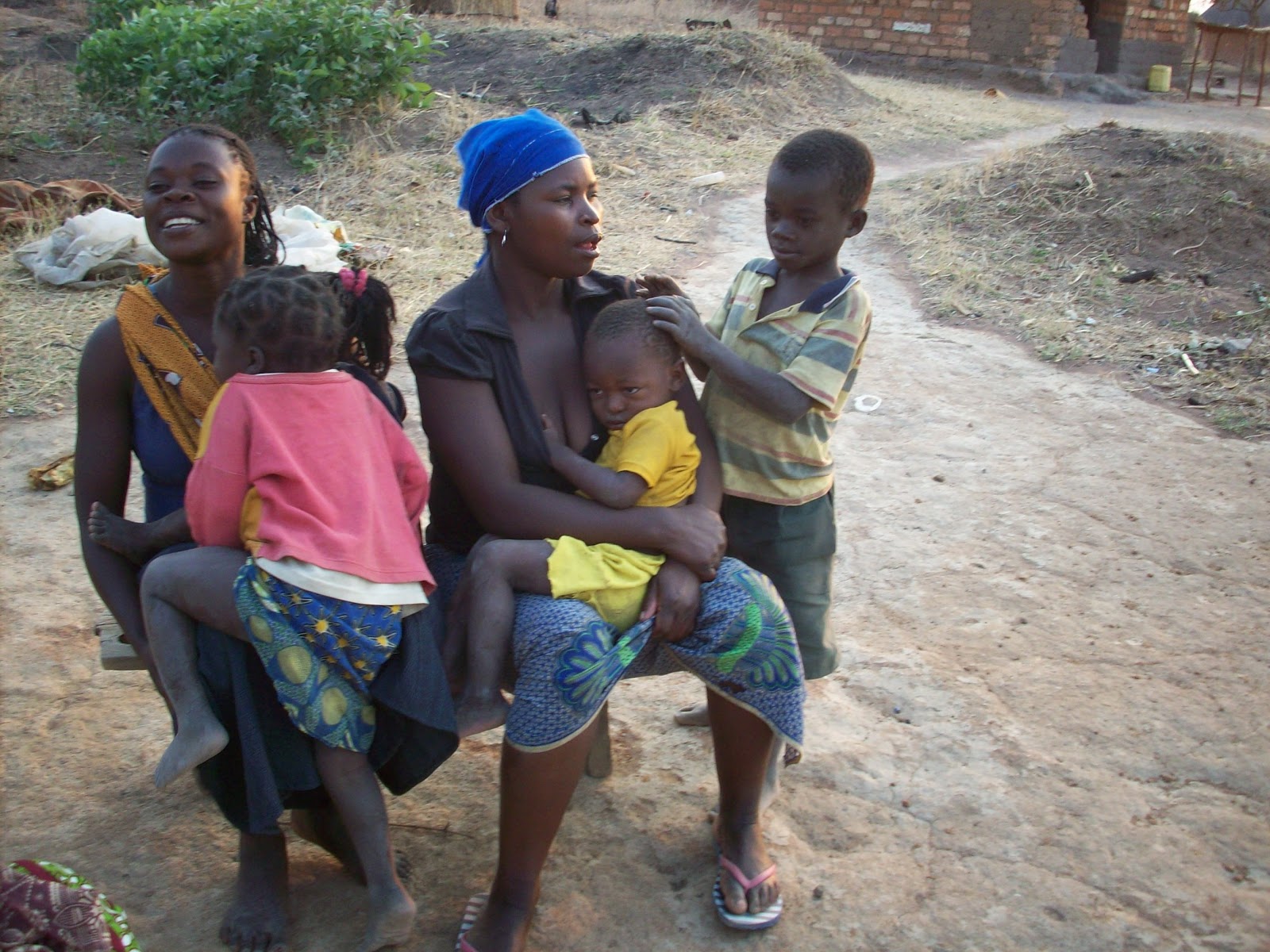
So how do poor Zambian mothers overcome barriers of behavior change and competing priorities? The answer is quite basic: they live in community. This is the single reason why I believe that Zambian children in rural villages could probably out-talk the majority of poor three year olds in the States. They are around their neighbors constantly. In America’s isolationist culture, each family tends to do their own thing. Their day does not start with a field trip to the neighbors house to get hot coals and comment on the weather. Most meals are not eaten with a group of other people. Americans do not find their entertainment in sitting and shooting the breeze for hours and hours, day after day. Zambian culture is oriented around the community as a whole – discussion, interacting, listening, responding. Poor kids in tattered clothes sit on our front stoop and talk about everything under the sun (and moon!) until hunger strikes and they shift their chatty-kathy convo around the nshima bowl. Their mothers, when tired of playing with the little ones, give the toddler to another mother who will talk to her, play with her, show her objects and ask her to do funny things. Babies get around. Toddlers get around. Little kids are movious (that’s Zamlish for “moves a lot” – not a word, but it should be.) As a result, they are exposed to different people talking to them all the time.


Bronwyn has benefitted greatly from this environment. Homegirl never shushes up. She sometimes grabs her fathers face with two hands, pinching his cheeks while she delivers a long and persuasive soliloquy. I think she’s speaking klingon, but the point is, she talks – she’s verbal, wordy, expressive.


She provides an interesting contrast to the American kids mentioned in the article in that she is technically growing up in a poor household. By the (American) numbers, we are not anywhere close to middle class. And yes, the fact that her mother reads the New York Times may have some impact on her verbal abilities. But I honestly contend that the number one contributor to Bronwyn’s obsession with communication is that she has a whole tribe (literally) of people, big and small, that talk with her. Like, all. the. time. Arthur Chanda stops by almost every morning to ask Winnie how she slept and what she is eating for breakfast and what form of pink she is going to wear that day. Bana Robert comes by to ask her if she wants to come and play and whether she has started running and to see if she has heard the latest village gossip. Her preschool friend Eliza and Beauty and Chiti sit with her for hours every afternoon and talk two inches from her face “Stand up! Stand up! Head, shoulders, knees and toes Winnie! Stand and sing of Zambia proud and free, land of work and joy in unity. Sing Winnie!” We may have to wean her of certain pronunciation flaws and remind her not to use words like movious when she is in America, but the point is that she hears language and therefore uses language. Your average American child, especially if growing up in poor household is probably hanging out with mom and a tv, and not a gazillion other people on a daily basis.


Spending millions to verbally tell mothers “talk to your kids so that they have higher IQs,” may be well intentioned, but Zambia has taught me that knowledge is not enough, poor mothers are thinking about other priorities, and life is best lived in community. What if we were to spend the time and resources in other ways – connecting families and helping mothers find social networks and tearing down fences and making play dates? I have a gut feeling we’d see more than verbal improvement amongst our economically challenged toddlers. We’d see a societal revolution! Now there’s a fix worth pursuing!


Monday, April 22, 2013

socialization


We had Bronwyn’s one year check up today with her pediatrician in Lusaka. Hepetitis B, Measles, Mumps and Rubella, you shall not conquer! 85th percentile in height and weight - huzzah!

Doctor Marsden was asking us questions about the things Bronwyn is able to do, like stand, walk, drink from a cup, etc and we found ourselves overwhelming our wonderful peds lady with info on how socially adept our daughter is. Oh first time parents, how over-enthusiastic you we are. We really got thinking abut all of the things that baby girl has picked up on. She has a whole repertoire of tricks up her sleeve that have nothing to do with standard physical development – things that she just sort of picked up... the invisible hand of socialization. Wow! Yikes! Oh my! I have very mixed emotions about this.

First, why I'm thrilled:
Watching Bronwyn play with the kids around her is pretty much the most darling thing I ever did see. I love that she plops herself down in the middle of their card games in our house and pretends like she knows what’s going on.


The boys taught her to drum on buckets and sing along and bop up and down to her own tunes. Last Sunday she crawled from the back of the church up to the front and began drumming on the choir drum while the choir kept singing and dancing around her.


I walked into the Learning Resource Center the other day and found that one of the little girls had strapped a baby doll to Bronwyn’s back. So sweet! They told her (in all seriousness) “don’t drop your baby – this is very important.”


She plays on the playground with the confidence of a five year old, climbing on things, having a grand old time, trying to figure out what mom means when she said, “be nice, take your turn, don’t be miss bossy pants…”


She has become a mini-mom, copying me in my daily chores, which is sometimes cute, sometimes messy.


We’ve realized that, without our noticing, our little girl has become a socialized creature! She has picked up and mastered the culturally mores of group play, rhythm and song, baby wearing, and domesticity. We ask, how did that happen? When did that happen? Who taught her these things?

And herein lies the worry. Socialization is cultural adaption over time, an influence of the general cultural and normative climate that positions an individual relative to the rest of society. The fact that personality and moral formation are happening based on Bronwyn's surroundings is absolutely terrifying. Bronwyn is a growing up as a third culture child. She is being imprinted by both Zambian and American cultures. But both cultures demonstrate characteristics that I really don’t want my daughter to “accidentally” pick up.

Playing with kids on the floor – awesome.
Learning a Zambian hierarchical structure or an Amerian dog-eat-dog mentality – not so awesome.

Drumming away on buckets( and everything else) and dancing and singing – awesome. Learning the Zambian “enticement” moves or the American sexualized dancing – not so awesome.

Growing into a wonderful baby wearing mommy – awesome. Defining herself as a Zambian baby-maker or an American “anti-baby-maker-cuz-I-want-a-career” – not so awesome.


Culture is complicated. There are aspects of every culture that should rightly be whole-heartedly accepted, those that should be outright rejected, and those that are simply waiting to be redeemed. My fear is not that my baby would become Zambian-American, but that she will become Zambian-American in all the wrong ways. How do I help her adopt the best of the two cultures, rejecting the wrong, and discerningly redeeming the rest? It seems to simplistic to think that “just” by raising her in a Christian home or teaching her daily how she ought to live that that will somehow save her from Zambian idolatry, poverty-mentality and degradation of women, or from American power lust, individualism and materialism. As I observe the kids around me, I make note of the fact that no one has verbally taught them the majority of their little nuances. Cultural osmosis has been the defining force in their life. The invisible hand of socialization has turned my little-people-friends into the full fledged Zambians they are – for better or for worse.


I don’t want Bronwyn to struggle with cultural identity. Nor do I want her to go with the flow and let the waves of culture sway her here and there. In my heart of hearts, I want her to belong to a completely different culture of a different world – a culture defined by compassion and justice and holiness – the things that make the joy-pursuit of this life come to fruition.

How do we lead her in that? To me this is the most important question as a parent whose call is to shepherd my child. As Jeremy and I talk about the cultural formation happening around us, we often feel overwhelmed, but at the same time we are thankful. We’ve both acknowledged that living in a place with a culture different from that which we were raised in, gives us a heightened sense of awareness regarding cultural nuances and their affect on our every day life. The typical American family living in a typical American neighborhood may never have a reason to stop and think about what messages society is sending their children and what character formation is stemming from everyday, secular influences. And yet this is the content of our pillow talk and our dinner conversation. Coming from one culture, living in another and trying to raise our daughter in a blended third gives us a keen sense of awareness. Even as we daily work through these questions, we give thanks that we are not passive participants in this giant social arrangement called community, but that we have been afforded the opportunity to parent intentionally. 

Friday, April 12, 2013

the culture of womanhood: babies having babies


I stumbled across this picture the other day. It was taken back in 2006 when Jeremy first came to Fimpulu. It caught my attention when I saw three specific girls all in one shot – Nsonga, Mwape and Rosa. Gosh, I guess we’ve known these girls a long time - look at these babies - was my first thought.


They used to come back to the farm and kick balls around and play cards and make fun of bachelor Jeremy having to cook for himself. When we got married, I spent a lot of time with the trio as well – having sleepovers, painting our fingernails and talking to them about school and boys and HIV, and trying to encourage them that good choices now would bring much reward later.

We also tried to work with these girls a lot on their English, realizing that language would be their number one pitfall in school. When they all failed 9th grade, we weren’t terribly surprised since, despite our efforts, they could hardly answer the question, “how are you?” They all opted to repeat 9th grade, hoping for better results. Unfortunately, their English comprehension levels didn’t improve overnight and again, they failed. We’ve believe that the girls actually anticipated their pending failure and opted for plan B – make babies. Before they ever sat for their final exams, all three girls were with child and showing. Mwape ended up marrying her baby daddy, Nsonga reluctantly revealed the father when her mother demanded compensation and Rosa pled the 5th and still won’t talk about it.


No more school, mommies by age 16, the cycle of poverty continues, and we lament. Girls, GIRLS – WHY? Where did we go wrong? I thought we talked about the challenges of having a baby and the opportunities out there and our commitment to support you and… and… and… Clearly we missed something. Or, on second thought,  maybe it has nothing to do with us. Maybe its not that we missed something but rather, society missed something.

Our suspicion is that these three realized that if they failed out of school, they would no longer be school girls, they would just be girls. Boring, immature, insignificant, little girls. According to Bemba culture, girls do not become women until they produce children. Mwape, Nsonga and Rosa determined that if their education (and therefore acceptability as little girls) was coming to an end, then it was time for womanhood to begin. To be out of school and not a woman would make them spinsters. Spinster - even I bristle at the word. How bleak and unlovely does that sound?

And so to avoid the embarrassment of both academic failure and spinsterhood, the girls played their cards according to culture’s rules. They produced babies, swiftly stepping into womanhood. I understand the game that is played. I’ve been laughed at twice this month alone because people think I’m lying about my age.
Almost thirty?  Haha, funny Bethany. You only have one child, therefore you are clearly not a day over, like, 20. (my sassy translation of the Bemba)
  
I’ve heard comments regarding my seemingly late debut into womanhood from old and young, men and women, educated and not. Furthermore, the tone and the respect level communicated has improved significantly now that I am a mother. Motherhood is highly valued in this culture. And therefore it makes sense that each of these three girls choose to be poor-but-respected mothers rather than well-off-but-disrespected singletons.


Culture has told these girls that, apart from having children, they are tiny, insignificant, incomplete and simply waiting to become. I wish so badly that I could find the right way to interact with young girls such that they hear the message that they already are. They’ve been women in the making since birth and will be until their last as children only teach us a different dimension of womanhood, not the whole of it. Their self-worth is grounded in who the Creater himself dreams them to be – so much more than “just” baby making abilities.

We are resisting the temptation to beat ourselves up over our perceived failure with these three girls. We will continue to love them, and their babies, through the ups and downs that are sure to follow. And we remember, that new girls are born every day here; important, significant, beautiful girls.

Beauty

Lucy

Doreen

Ida

Natasha

Bronwyn

From afar, will ya’ll help us love on these ones in the same way you love in mine?

Monday, April 8, 2013

new years resolution


I’m making a new years resolution, and no, I’m not three months late. I’m right on time. My life clock hit the reset button on March 25th 2012 when Bronwyn entered our lives and changed us forever. Now, one year (plus a few weeks) later, I find myself reflecting on the nature of that change. Just the other night Bronwyn lay sleeping at an angle in the bed, leaving Jeremy and I to cozy up on the other side and gaze upon our slumbering babe. All stretched out, I saw how long she is getting and I whispered to Jeremy, “she’s huge… I remember when she was half this size.” And that’s when the tears started to fall. I do remember when she was half this size, and I remember how much I wanted her to hurry up and get big so that I could get back to work. A rolly baby without the ability to sit up on her own meant that I carried her everywhere, holding her even while she napped and talked often about how I was “stuck” with this infant and felt guilty that I wasn’t doing something more impressive, and worried that I was a truly pathetic missionary.


“Why did I ever complain?” I said to Jeremy. In the grand scheme of things, that season was a blink of an eye. I’m so ashamed that I wanted it to go faster, that I valued my freedom over the gift of beholding my ever-changing child. “I shouldn’t have been so concerned with multitasking,” I said. “I should have just sat there and stared at her. I mean look at her now! She’s gorgeous.”


Bronwyn’s first year has been full of transitions for our family, but I think I’ve changed more than anyone. I’ve learned more in the last year than ever before about dying to self, living in humility and finding my worth in Christ. I still regret the fact that I didn’t cherish every second of Bronwyn’s first year in the ways that I should have, and I’ve amended my heart’s priorities in such a way as to assure that year two is different. Bronwyn’s Bemba name, Bupe, means gift, and that she most definitely is. As we recover from her crazy birthday party and return to life as normal, we reflect on the divine nature of this gift, hand selected for us since eternity past, entrusted to us for the present, and instilling in our hearts a passion and anticipation of the future.


Thank you Lord for the gift of a child. She is first and foremost yours – but thank you for letting us shepherd her for now. May we treasure these days.