Showing posts with label incarnational ministry. Show all posts

Friday, November 26, 2021

dirt coffee: on evaluating worth in a material society


I recently started taking care of an older woman for whom a simple scratch had become a septic wound larger than my hand. The wound festered on top of her collar bone which protruded from her skeletal frame. Every inch of her body bore testimony to her 70 something years of life. The scars of traditional medicine on the chest; the feet calloused from thousands of barefoot miles; face lines of one who has both smiled and scowled plenty. Such a body is magnificent in a place where the average life span is twenty years her junior. 


Some days I had to hurry through the dressing change and move on to the next thing, but other days I had the luxury of sitting and asking questions about her life – childhood during colonialism, marriage and her now deceased husband, the role of the matriarch. Dozens of toddler sized look-alikes flitted around her – the older ones sitting and listening as intently as I. She always seemed surprised by my curiosity, her broad smile telling me that she was grateful to be known. 


One day at the end of our conversation as I loaded my medical tub to schlep to the vehicle, she looked up at me and said, “Don’t die, Bana Winnie,” – a benediction of longevity. 

“I’ll try not to,” I said back. 


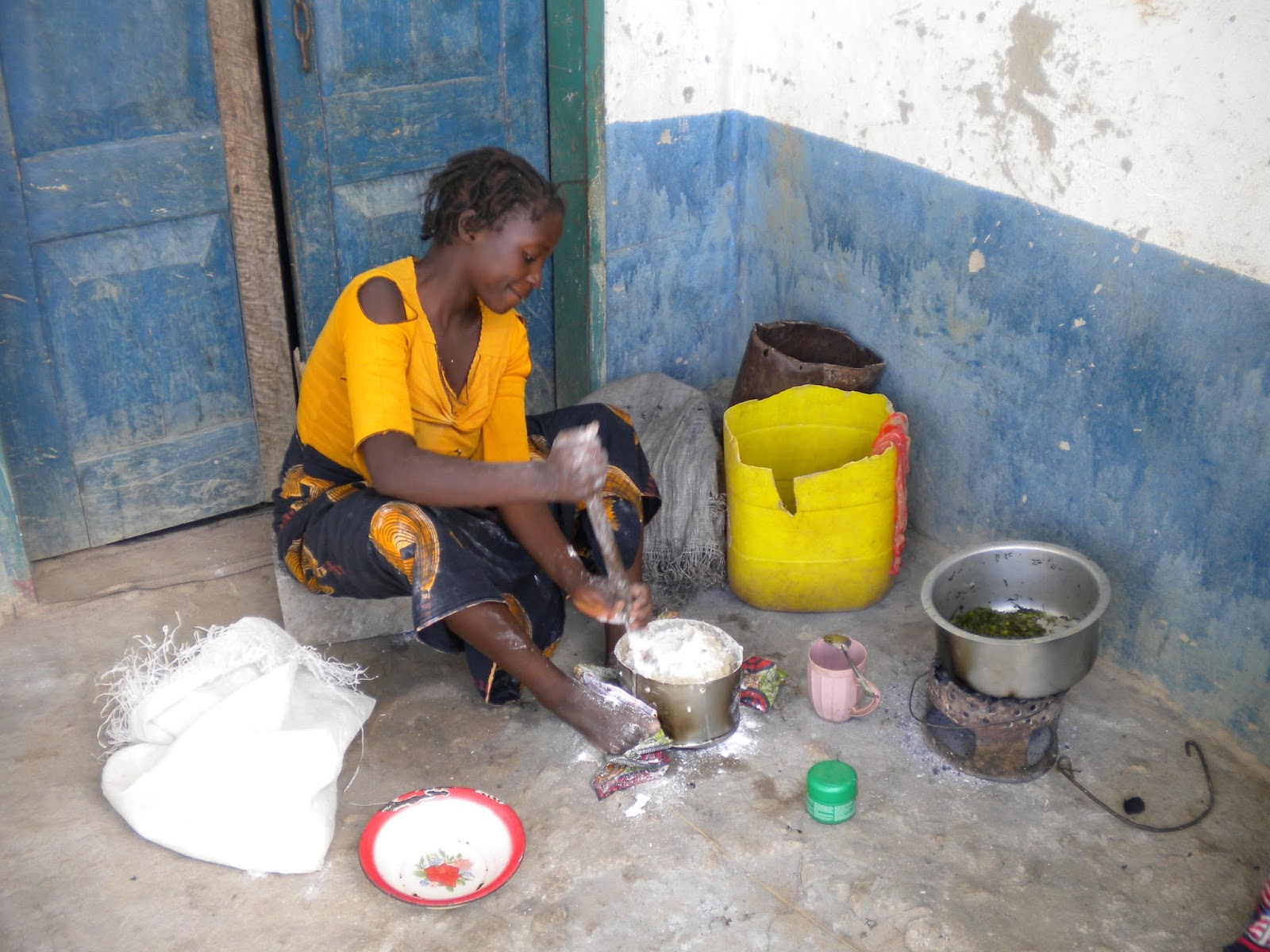
As grandma began to heal, her adult children confessed that they hadn’t believed she would recover. Given her age, general fragility and the severity of the wound, they expected to be saying their final goodbyes. Choosing to ignore their lack of trust in my wound-care skills, I rejoiced with them at how well she was doing. After that point, I rarely left that home empty handed. After the sterile gauze had been taped onto her paper-thin skin, grandma would slowly rise up from her mat on the ground and say, “I’m coming,” which in this culture implies, “don't move.” She would go into her tiny brick house and come back with something for me – dried cassava, freshly harvested peanuts or whatever her children, grands and great-grands had pulled from the fields that day. The day she asked how I like caterpillars, I had to think quickly through the pros and cons of accepting a gift that was a delicacy for them and not so enticing to me. But then one day she gave me something really special – a little sachet of coffee. The day before, Grandma had shown me her single coffee bush next to her house. She explained that she picked the beans, heated them in a pan over the fire, pounded them in her mortar, sifted the grounds and then drank it. She asked if I knew what coffee was. Indeed! I responded, explaining that the culture I come from is a little bit obsessed with it. The grounds she gave me were wrapped in a yellow strip of used plastic bag, tied around the powder and very much looking like contraband. I said thank you, and I really meant it. 


I took the coffee home and opened up the sachet. I smiled, remembering an incident several years earlier when I had taken bags of Zambian coffee to the states as gifts for donors. Thinking I was being cute, and not knowing any better, I gave an adorable burlap, hand-stamped bag of ZamCoffee to the owner of a successful PNW coffee shop. He opened it, sniffed, and simply said, “Oh wow it looks like dirt.” Slightly stunned at the critique in lieu of “thank you” I accepted that maybe I should have known better. (He wasn’t the only coffee connoisseur on that trip to inform me that Zambian coffee is definitely sub-par. Its ok, my wounded pride has since healed.) 


But there in my own home, as I unraveled the grimy plastic and looked more closely at the locally-grown, pan-roasted, home-ground coffee in front of me, I thought, this coffee kind of does look like dirt… and yet I love it. I brewed the cup and took a sip. Having worked hard to become more discerning since that original snafu a few years ago, I couldn’t deny, this coffee would never pass on the world market. Or in any market. Ok fine, it was barely palatable. And yet as I sipped, my mind traveled not to hipster coffee houses but back to grandma’s soft face and her boney hands which had given it to me. The coffee was simultaneously disgusting and precious to me. I struggled to finish that coffee, but also savored it in honor of the hands that made it for me. 


A definition of poverty that I have latched on to is that of having little to nothing that the world deems valuable. “Grandma the wound patient” definitely has little to nothing that the world deems valuable and yet she had become so much more than that to me – she was rich in history, tender with babies, tough on teenage boys. She rarely moved from the sack on the ground, and when she did, it was slow, measured movement, that communicated determination, intentionality, and resilience. Her generosity humbled me daily. The day we both attended the funeral of a neighbor lady – her friend – I asked her how she was doing and she said, with wise eyes, “I’m alive.” Gratitude. Character. Grounding. This woman’s coffee did indeed taste like dirt but to me, her mere existence - painful and labored as it may be - was and is of immeasurable worth. 


As a community developer that tackles the mammoth of poverty alleviation, I notice how much time we spend evaluating projects and programs based on how productive we can help people become. The things we encourage people to do simply because “there’s a market for that;” defining worthiness by whether the people with fat pockets are willing to pay. The system makes sense, considering that the drivers of development are descendants of the protestant work-ethic who have signs that read “He who doesn’t work doesn’t eat” hanging in their kitchen. In essence, that phrase which the West considers a “Capital T Truth” basically means, if you aren’t willing or able to produce something that the world holds valuable, you don’t deserve to be kept alive. It’s possible that this paraphrase sounds more hyperbole (and dystopian) than it means to be, but I think Grandma’s dirt coffee has me seeing more clearly.


Today is black Friday, the day which ushers us into the most materialistic month of the year and, I fear, the worst version of ourselves. We want the stuff, that much is clear, but do we want the stories? As we hold things in our hands, are we giving thanks for the hands that have made it? Are we equating products with dollar signs or equating persons with infinite worth? When we commodify others, we dehumanize ourselves and I can’t help but feel like we are missing out on the massive opportunity this season would otherwise afford us to become a little more real. 


The mystery of the incarnation is that God came to earth, tasted our coffee and said, I see your worth. The coffee tastes like dirt - I can’t lie - but your worth? Immeasurable.

God became poor so that in our poverty, though having nothing, that paradoxically, by virtue of embodied glory, we may possess everything. 


The world has a ton of leverage over us – impacting the way we see ourselves and others, as doers first, be-ers second, worthy of dignity only if the market agrees. Grandma’s coffee was nowhere near good enough to be valued by anyone that matters which means that she will live out her days unknown by people who haven’t seen in her face all that they are missing. But tasting and seeing go together, so drink the coffee. Bless the hands that made it. Savor the stories. See the worth. 


 As a post-script, if you are interested in spending money on things that promote the dignity and infinite worth of people, may I suggest these options: GIFTS THAT MATTER.


Tuesday, August 4, 2020

where is the hope


A few days ago, I messaged one of my nurse friends. “I think I can be creative with Mary’s bandages until the next crate arrives… as long as no one else gets burned.” Today, a little girl whose pants caught on fire showed up at my door. It’s when your ‘just enough’ turns out to be too little that hope comes hard. 


My friends who thought they just had to get through the summer are feeling this too. ‘Just enough sanity’ to survive till school starts has been hijacked by school not reopening, and I see a familiar hopeless look in your eyes. 


As I lifted the little girl into my tub, giving her Tylenol and cookies to distract her from what was about to happen, I sized up the damage. Thirty percent of the upper thigh, not over any joints. “The clinic sent you home to care for it yourself, didn’t they?” I asked, judging by the gooped on toothpaste and ashes that are considered “traditional medicine” for burns. 


Back home my friends are cleaning up different messes. The protest fires of injustice and racism and hate are blazing in Portland and elsewhere and the “traditional medicine” of white supremacy doesn’t debride without tears either.


Where is the hope?


The little girl started crying as I slowly rubbed away the crust that was clinging angry to the tender flesh. Not recognizing either the girl or her mom by face, I asked where they live. M’wanguni, the mom said, in between telling her daughter to not cry so loud. “That’s two villages over,” I observed, “How did you know to come here?” “I heard from the man whose finger you fixed that you were kind to people like us,” she explained. Ah yes. The man who presented me with a severed finger that the clinic wouldn’t touch except to cover with a square of gauze tied on with a condom. 


It’s never ending, the wounding is. For me or you. Breonna Taylor’s murderer still walks free; the poor are being pushed farther out of affordable housing; and demon sperm lady is practically surgeon general.


Where is the hope? 


There was a time when scenes like this would have wrecked me. More times than I can count, I’ve left a bleeding person alone in my bathroom so I could go outside and sob heavy. And while I’m holding tight to wound supplies and not BLM signs, I feel your pain too – I do. That I can’t march with you, that I can’t help teach your kids’ pod, that I can’t hand you Tylenol and cookies while we tackle this life together – it grieves me in its own way. 


Where is the hope?


I want to be optimistic; that the Tylenol will take the edge off, that tomorrow the pink skin will magically be brown, that medical neglect will no longer send people to my door. I want to be optimistic for you too; that the Covid curve will angle down and that black communities will be lifted up and that music will return to your streets. 


I love the optimists in my life, and I aspire to be one of them. Deeply connected to heart’s desires, goal oriented and stubbornly positive. Optimism motivates us to take risk and study burns and speak truth to power. Optimism serves us well… until it doesn’t. When the next patient is more critical than the last and the next tweet more heinous than the first it’s a sucker punch to the gut and all those Pollyanna thoughts feel childish. Confrontation with reality has sent more than a few optimists into rehab where we’ve tried to make sense of how we could have been so naïve. 


Where is the hope?


Wiser, more experienced, we get our act together. I order hundreds, not dozens of bandages at a time and silver sulfa now by the gallon. You round up screen shots for facebook ammo and amplify black voices as we try and figure out how to realistically achieve this thing we call healing.


But our expectations are tempered more than we admit. Where we no longer pray for miraculous healing and justice is only preached to the choir. Those brave desires have been swapped out for a safer, more cynical version… but at least we’re being realistic, and that feels grounding… though depressing in its own way. 


Where is the hope? 


Not knowing how to show up for myself, or you, or anyone, I show up to therapy and try to figure out where I am. I learn that the place I find myself is squarely in-between. I learn that God gave us two hands for a reason, so that we might remain deeply connected to our optimistic dreams while also deeply connected to the world’s brokenness. In the space between, wanting so much, and seeing so little, we feel the tension in every cell of our bodies, which opens the possibility of discovering that this is where hope is


When healed patients feel loved through hours of connection, I find meaning in the pain. Now  I’m hopeful, instead of devastated, by each new story that reaches my door. As I’m watching America from afar, seeing the end of conservative evangelicalism and the emergence of fresh faith, I feel hope for you in so many ways too. Hope lives in the already and the not yet – where we believe that change is possible while still sensing how broken we are. Where the light shines bright and yet darkness still permeates. Where heaven has come and yet is not fully here. This is where hope is.


Lament puts words to the insanity of it all. With space for both the longing and doubt that makes us human: That what we experience is awful, but not beyond redemption. That I’m powerless to fix it but I’m empowered by the one who can. That the-God-who-sees is made of everything I am not. That evil is pervasive but there’s more grace than I know. Lament roots us in hope by declaring that suffering is real, but mercy is near, and if everything we long for falls apart, the shattered dreams will, in faith, become the building blocks of a surprising tomorrow. This is where hope is.   


And by sowing tears and reaping joy we carry on, hoping against hope that we won’t be disappointed. As I optimistically wrap wounds and realistically still dispense the analgesics. As you optimistically cast your ballots and realistically pray in closets. We can go to task and then go to sleep because the results are not ours to manufacture. It’s in the space between optimism and reality that hope thrives because that’s where God is, involved in what is, working out what will be, and actively transforming everything in the process. And for this reason, and this reason alone, it will be ok. 


Hold on to hope, my friends. Let’s hold on to hope. 


Friday, April 1, 2016

why our children NEED a multicultural community

If I got a nickel (or 50 ngwee) every time I heard “because that’s the way we do it!” I’d be richer than rich… in multiple currencies.

Bush work is hard for many obvious reasons. The lack of resources and infrastructure make even moderate growth a super-struggle. The environment is actively trying to kill us. Language barriers. Snakes. No road signs.

Friends, there has not been cheese in Shoprite since forever.

The straw that tips the scale though has to do with (surprise, surprise) - PEOPLE. People are people the world over, but when it comes to facilitating development, rural communities, by virtue of their homogeneity and isolation, tend to experience the greatest conflict.

The majority of Fimpulu folk had never seen a white person before the Peace Corps spit me out and we started our dance party. It would appear that that was the first time my neighbors realized that there were people on the planet without natural rhythm or an inherent understanding of Bemba or built in SPF.

In those early days, I did absolutely everything “wrong.” I rolled my nshima wrong and washed my dishes wrong and tied my chitenge wrong and pronounced every word wrong. I owned the wrong kind of cooking spoon and I braided my hair wrong and I owned the wrong flip flips (I’m unwaveringly loyal to my Reef Gingers).

getting it. but still insisting on wearing reefs.
 Over time, I learned “the right way” to do most of these things, and since then we’ve all been getting along royally. More importantly though, I learned just how deep the waters of culture go. In the contest for behavior change, the more insular the culture, the more loyal its patrons are. To cultural adherents, new ideas are neither “interesting” nor “compelling.” All things “different” tend to be, at best, “wrong” and at worst, “dangerous,” neither of which is particular conducive to willful adoption of change.

Here in Fimpulu, there is exactly ONE right way to cut and cook leafy greens. There is ONE right way to acknowledge a sneeze. There is ONE right way to hold your arms when you are in trouble.

I spy eight things in this picture that are "culturally informed"
The vast majority of cultural nuances are harmless. Is it really that bad to go through only life tucking instead of tying your chitenge, or avoiding making eye contact with your in-laws? Probably not. (Don’t stress, I love my in-laws).

But what if the behavior isn’t so neutral?

What if your soil stops yielding because you burn it to a crisp every year?

What if you’re chronically constipated because you refuse to drink water before noon?

What if your newborn goes septic because of the way you cut the cord?

What if you’re in debt for the rest of your life because you had to “buy” a spouse?

What if your hair turns orange and your eyes turn red because you think maize is the most powerful food on the planet?

What if you are trapped in unhealthy and dangerous behaviors because you simply cannot conceive of a different reality.

on top of the world really? or matter or perspective
I have this kind of conversation no less than once per week:

Nope, you do not need to put ashes on your babies soft spot. Nope, your child will not starve to death if you exclusively breastfeed until six months. Nope, you cannot contract HIV from witches. (Unless you are sleeping with them. And don’t do that.)

No really, you must drink more than two glasses of water a day. No really, you don’t need spiritual cleansing for having touched a dead body. No really, your baby will be less cranky if you take the six layers of wool off of her. No really, your money does not make you spend it.

I basically eat skepticism for breakfast
The NGO world has led us all to believe that what people need is information. Just tell them, they say... and billions of dollars go towards this end. But there is a category of information out there that is ages deep and miles long that people suffer to understand because it is so far from their perceived reality.

In closed cultures, nearly everything is etched in the ancient trees. How and why things are done is a woven story, passed down from generation to generation, with all the authority of every person who has ever walked the red-dust-bush path. In this context, divergence is considered neither noble nor brave but rather rebellious and haughty.  Compliance is the MO and asking why is a fool’s game.

These footprints tell a far deeper story

New ideas, however brilliant, are filed under “foreign” and received with polite dismissal.

Oh how nice that white babies’ soft spots close naturally. But this is how we do it.

Oh how nice that those pills prevent pregnancy in white women. But this is how we do it. (Or not, as evidenced by your ten children, but whatever.)

Oh how nice that white people like to put peanut butter on all of their food instead of eating nshima three times a day… BUT THIS IS HOW WE DO IT.

trying to perceive a different reality

The statement would be fine except that there is no 'because' at the end of it. No reason. No rationale. No research. We do it because it’s the way we do it. Even unto bankruptcy. Even unto broken relationships. Even unto death.


It would be too easy to criticize these closed cultures, waiting impatiently for them to get with the program. But the longer I live here, the more I realize how much my own cultural upbringing taught to me these same “but this is how we do it…” ways of thinking.

It wasn’t till I moved to Africa that I learned that you could let people wander in and out of your house without that being a violation universal human boundary. It was here that I learned that sometimes you work your tail feathers off and still don’t get your just deserts. It was here that I learned that you can agree with a democrat and not lose your soul. It was here that I learned that you don’t have to cook scrambled eggs in the microwave.

MIND BLOWN.

Bronwyn makes a really good "mind blown" face for me. Leonie just hates loud noises.
No seriously. I learned that its ok to pick my baby up when she cries and that boobs in public are whatever and that stuff is just stuff and fences make awful neighbors. I say often to my friends, America isn’t perfect either… But truth be told, it took leaving my culture to believe that.

Despite having grown up in a diverse town, I led a rather insulated life which I can best describe as “simplistic.” My friends and I found it easy to scoff at others because we “knew” the “right” answers which flew out of our mouths without pause. I have to wonder whether so many of my peers went off the deep end in early adult hood because they lacked the life skill of productively processing cultures outside of our conservative evangelical bubble. I also have to wonder what life would have looked like had I begun my “African awakening” at the age of 2 instead of 22.

She's lucky to have him
Cultural acquisition begins early, and I’ve enjoyed watching the slow-mo-assimilation-show play out gradually in my own living room. As I raise my children in this hybrid land of white and black and all the grays, I want them to have exposure to the breadth of philosophies about life and opinions in motherhood and ways of cutting and cooking their vegetables.
 
she looks super white... but I guess in some ways she is...
Please hear me well: The goal is not to raise moral relativists who lack conviction. The goal is to raise intellectually responsible Christ followers who are empathetic, global citizens. I firmly believe that exposure to a multi-cultural community is essential in achieving this goal. 


We love our kids and are responsible for their upbringing. We will, therefore, teach them the all the things that we believe to be important, and make for darn certain they know WHY.

We will teach them that Jesus is the greatest and that justice might mean getting the short end of the stick and that cheese sauce makes everything taste better. We will introduce them to people we call friends who deviate from our stances… not as a tactic to make them feel superior but to help them grow in empathy and resilience as they wrestle again and again with the questions of why we do what we do.

Having learned something from our Fimpulu neighbors, I want our kids to not only be able to conceive of a different reality but also to interact with it, digest it and grow in heart because of it. 

Bronwyn with the chefs at our fav Indian restaurant in Lusaka. Because there will be curry in heaven.


Leonie with the same chef.

No blind following. No blind arguing. No blind dressing and cooking.

No blind mothering or working or living. Health and happiness and heaven matter far too much.

Mwewa matters. So much.


Culture is a gift and the mish-mash of different cultures a greater gift still.

And our children NEED it.

they need each other


In what ways do you find it easy or difficult to introduce your children to a multi-cultural community?

Wednesday, February 3, 2016

the idolatry of minimalism

Spawned by a 1970’s art history movement, minimalism became the choice descriptor for simple art and design. It kept a low profile for several decades until something (the mystical powers of the mommy bloggers) in America caused the term to broaden its meaning beyond art and into every day life. Suddenly, the internet was giving us all the directions on how to downsize our wardrobes and discard nick-nacks and shrink paper piles and everything in between. Minimalism spawned whole new species a la minimalist parenting and minimalist cooking and minimalist hairstyling – and bit by bit, the fad became wisdom and we all realized that fat and cluttered and complicated were not actually recipes for happiness.

I bought into the minimalist philosophy long before I knew it was cool, long before Becoming Minimalist started telling me to do all the things I was already doing. My first house after college was a tried and true minimalist hut. The entire structure was made of earth. Good, clean dirt and grass and water and clay. I especially loved my dirt floor – I could drain my pasta water right next to the fire which was also dropping embers onto the floor of my kitchen-living-dining room. It was infested with rats and bats, and I loved everything about it. (The Peace Corps tends to attract not-high-maintenance people.) I had no furniture save a bed, a table with no chairs (because the village carpenter was clearly not looking for money) and a rough hewn shelf. And it was all I needed.

Not what most Americans think of when they hear "starter home," but I loved it.
Also, unrelated side note: baby face Aggie on my left there is graduating from high school this year. *tear*
Marriage and children pushed my minimalism boundaries a bit. Jeremy insisted on a not-dirt floor. I'm a good wife, so I conceded. When Bronwyn came along and started sleeping with us and none of the spaces in the house was big enough to fit our new bed, change was necessary. Bit by bit, we've pushed walls around and added a few amenities, taking a “step up” every year or so… and every time, I’ve felt super guilty about it. It’s like my inner minimalist is being asked to commit perennial felonies and I hate it.

I still find the simplicity of it stunning

the bungalow/rondoval/yert we custom made to fit our co-sleeping bed 

this is how we reno: Jeremy with power tools on top of a chair on top of a chair on top of
a table being stabilized by three boys pretending they are Jet Li. Call us for bookings, HGTV.

Principled is my middle name, and my minimalist principles are chiseled on stone tablets. One of the principles of our work is that we live with and like those around us. We believe strongly in the power of integration for effective communication and we’ve seen the fruit born of such an ideology. Rich people living amongst the poor must acknowledge the baggage they carry unless they want their dialogue to sound like this:

 “Hello! My name is $$$. I’m so happy to be here for the sake of $$$. Would you like to partner with us on $$$? Maybe we can get together and talk about $$$? Ok, well sounds like $$$ would be a good idea? Let’s chat more about $$$. Thanks! Bye… $$$$!”

True story: I have actually had people greet me (outside of Fimpulu, thankfully,) with the words, “Hello, Dollars!” Its crazy unsettling and it totally confirms the need to establish a different name lest we adopt $$$ as the super-inappropriate default.

Hard work pays off, and I’ll be purple duck if living in the bush doesn’t qualify as hard work. After several years, people commented on it – a lot – to us and to others. “Hey, there are these white people in our village and they live in just a house like ours!”

I’ve heard that no less than a dozen times, and I always pat myself on the back a little for it.

happy little homesteaders
Equally strong as our convictions around simple integration are our convictions around the science and theology of minimalism. Studies have proven that less clutter correlates with greater happiness and verily verily, we can attest that throwing junk away feels good. Furthermore, Jeremy and I are both proper Sunday School graduates and we know this to be true: Don’t store up your treasures on earth where moth and rust destroy. Have less crap, says the Teacher. And all God’s people shouted Amen.

But life is a forceful tutor. My baby got malaria. And then she got it again, just as Jeremy and I had too, and this happened over and over until our family malaria count is somewhere around 20 and we stopped counting because that’s silly. Our roof started to slowly dust away to nothing and we unloaded 10 cans of insecticide to assassinate the beetles eating it, and I don’t even want to think about the brain cells we killed with that choice. We’ve all had weird skin ailments and are far too comfortable with conversations about diarrhea. We had a season of hairy spider infestation too. Our newest thing is that we now have an indoor “water feature,” a tranquil waterfall flowing down the side of our kitchen wall collecting in a small pond that touches every square inch of our living room. So vogue.

One afternoon, I watched Bronwyn skype with Grandma, naked and fevered, lying on the floor and looking painfully pitiful. To say that I felt like a bad mom would be an understatement. That same day, Jeremy read me an article from a study in Uganda claiming that tin roofs, when compared with grass, saw a 50% reduction in the incidence of malaria. The wise husband started asking me if we should make some changes and I said “NOOOOOo!” faster than he could say “MALARIA.” My heels are dug in pretty deep in this Zam-mud. I dogmatically recited our mantra. "We live simply. As do our neighbors. If they can do this, so can we. We do not need more comforts than what we have. We. Do. Not.”

But I slept on Jeremy’s question all the same. For many nights... and mornings, mopping up the lake in the livingroom and dumping the mosquitos out of our little night-light-bug-sucker thingy and swabbing anti-fungal goo onto Leonie’s face and killing all the spiders of the world for Bronwyn.

The staunch conviction that we must live JUST like our neighbors started to waver a bit as I was rattled by my lack of hospitality towards my own children.

Hey Guilt Hey! Our minimalist principles are hard and fast, and so by conceding to change, it felt like we were wimping out, throwing in the towel, and embracing that which we’re most adamantly against. In our case, however, “go big or go home” is more than a tagline. It’s a mandate linked to real possibilities and real consequences. We understand that if we don’t take care of our family, we’ll have to opt out of this gig all together and it would behoove us to make sure that doesn’t happen. Alas, the hubby is right.

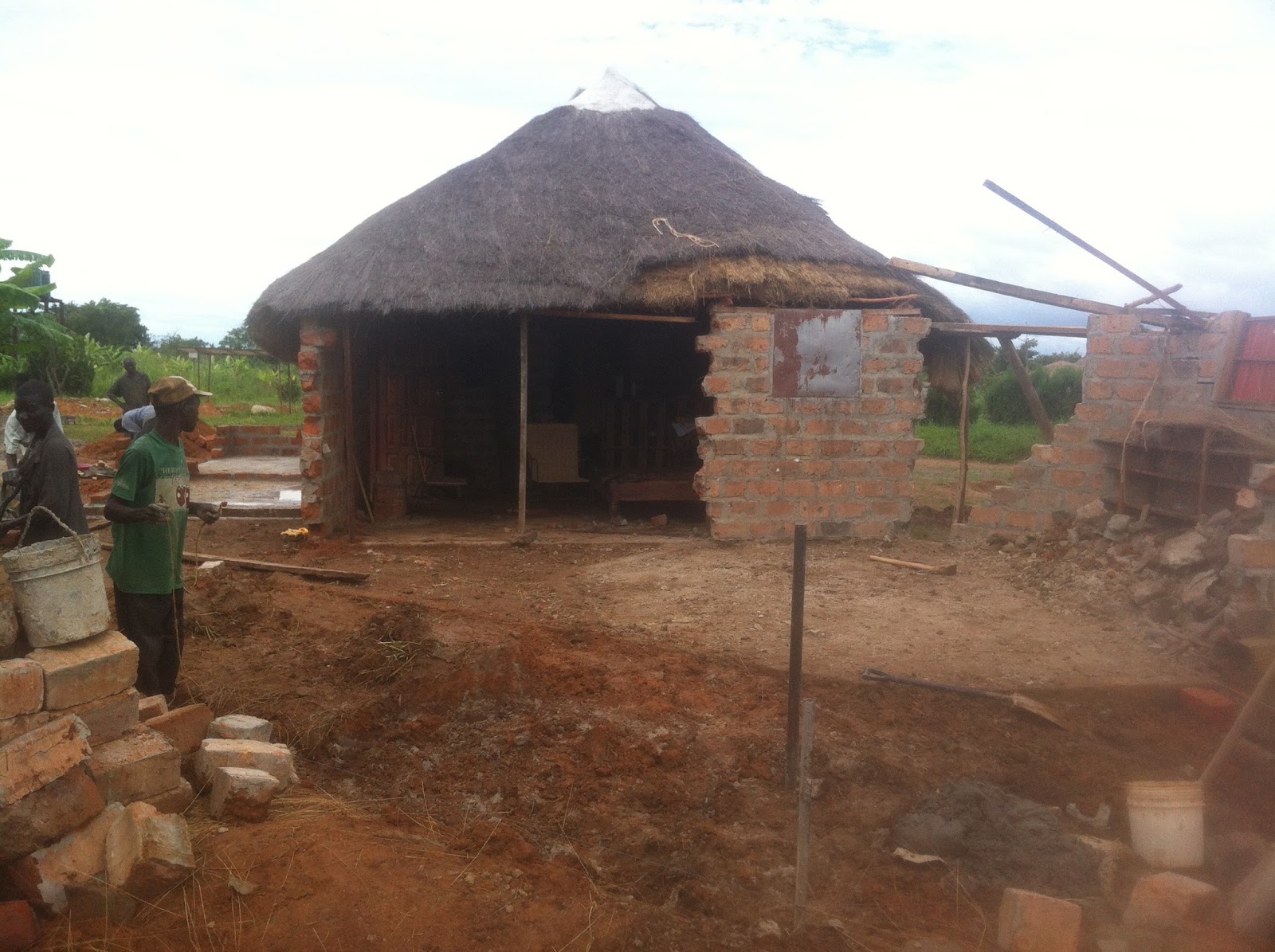
We’ve emphasized how simply we live to everyone who has tracked with our work. It’s kind of been a thing we may have bragged shared about more than once. (oh hey extra layer of guilt). But we’re going to have to change our story. Because we done gone ripped our roof off. We sure did. We tore some walls down and we we have begun operation hospitality: the effort to turn our house into a home. Dear everyone, the goals have changed.


Once upon a time, the goal was to live as simply as possible, idolizing minimalism and embracing an almost-ascetic brand of discomfort. I judged hard-core anyone who commented that they couldn't live like we do because truth is, yes you can - we are not special. But. Just because one can doesn't mean that one has to or that one should, and I've spent near on a decade parsing this distinction out. There’s a difference between seeking comforts because of a materialistic spirit and/or an immature avoidance of hard things... and seeking to not be so sickly and tired all the time. 

The goal now, therefore, is not to live comfortably, but to live comfortably enough. To have enough space that we can think and breathe without thinking and breathing on top of one another. To have enough of the household amenities that we aren’t stressing our bodies or our time to complete basic tasks. To have enough distance from the outside that we don’t feel like we are at constant war with the environs. To have enough aesthetic beauty to lift our spirits when needed. To have enough rooms and bed space so that the parents don't have to sleep with all of the kids forever and ever amen!

Enough.

Not all the comforts, not more comfort for more comfort’s sake, but enough.

Enough is defined by a matrix of culture and age and personality and gumption and grace and when it comes to "how much is enough," one size fits all is inadequate and lame. We have had to draw the lines in our own (literal) sand, and we've done so prayerfully and with great forethought. 

There have been seasons when we've embraced less for less’ sake, and we’ve hurt ourselves. We stand actions of starting off in the village sans fanfare. We acknowledge that it is because of our early choices that today we are not dollar signs, but rather friends, neighbors, helpers, and co-workers. By the same token, it is because of our history and friendship that at this stage in the game no one gives a rat’s rear whether we change our roof or add some square footage. Truly, they don’t care. Because after nine plus years, surprise, surprise, the intrigue is gone, and people are genuinely happy that we are doing something nice for our family. (Confession: because guilt is a twisted friend, I compulsively polled people on this to make sure we weren’t making a huge mistake and that our friends would not covetously despise us forever. Weirdo.) But when we received the equivalent of the Papal blessing from the neighbor folk and the grass came flying off the roof, we knew it was ok.


When we were fresh and pink and smelled like we had just stepped out of Wegmans, the people of the village were watching to see what we were all about. Now years later, we have children, and THEY are the ones watching to see what we are all about. As a principled mother, I want them to see frugality not futility. I want them to see moderation, not masochism. There’s a way to not bow to the god of mammon and still care for your body, mind and soul… and there’s a way to responsibly spend the money to do so.

Today I stood in the original house, the one the size of my parent’s bathroom, stroking the walls and tearing up, saying to Jeremy how I would miss that precious structure; the one in which he carried me over the threshold, to which we brought home our first child, where we made a name for ourselves in more ways than one.

"We’ve come far," he said. "And we’ll go farther still," and back to demo he went.