Showing posts with label women. Show all posts

Monday, March 2, 2020

how to grieve: an African primer


I lost my fourth and final grandparent last week. This is the third family death since I’ve lived abroad, and I haven’t been able to return home for any of them. I’m ok with it, in a resigned way – death is a part of life, and missing out on major family events is an expected consequence of working overseas. It has gotten me thinking though.

You know, we’ve attended maybe 100 or more funerals in our time here. With a life expectancy in the 40s and an environment that is constantly prowling for its next victim, death literally comes with the territory. While there are many cultural things that we haven’t gotten used to – such as eating chicken feet or not looking people in the eyes – grieving in the style of our neighbors is different. We are more than used to it – it has become our way of grieving too. It just feels right.

I remember one of my earliest conversations here, as someone asked me about grief and mourning and funerals in the United States. I explained that usually a service would be scheduled and people would attend, and that close relatives would check in on the bereaved afterwards, and others might bring a meal, but that mostly people preferred to mourn privately. My neighbor looked at me with so much concern as if I had told her that Americans grieve by snorting crack and she just said, “Oh Bethany, that’s not healthy.”

I had no idea what she meant by that, but now, with what feels like a century’s worth of funerals under my hat, I appreciate where she was coming from, and I agree with her. Americans mourn the way they do for cultural reasons, not because a band of emotionally intelligent people came together and said, this is what is best for our hearts. The way grief is handled in our community just feels healthy and I wish that all of my friends could experience it the way I have. 

Most recently I attended the funeral of a young boy who died after the clinic refused to call an ambulance. I’ve written about the local ambulance situation before, and again, this death affected me deeply. For many reasons – it’s not our responsibility, we are busy right now, we’ve already gone to town five times this week ­– I declined to take the child to the hospital myself, and when he died, the weight of that decision absolutely crushed my heart. I knew that I needed to be present at that funeral and took myself there immediately. 

Funerals start the moment a person dies and I arrived to find the bulk of the village already gathered, as was expected. In village life, whether you are intimately acquainted with the deceased or only knew him as that kid down the road, funerals are whole community events. The commitment to mourn together reflects the belief that mourning is not only important but also that we need each other to do it well. 

I entered the funeral house which had already been emptied of furniture to accommodate the masses who would be moving in. The body of the child whose soul was no longer with us was laying in the corner, a woman next to him swatting flies from his face. The mourners had already begun their work of shedding raw and restless tears and I received gladly the permission to begin releasing my own. I beelined it to the mother and kneeling, draped myself over her. Instinctually, I clutched her thin body, her head immediately resting heavy on my shoulder. As her sobs grew louder, I just bellowed over her, “I’m sorry mama, I’m so sorry I didn’t take him, I’m so sorry.” I leaned into the catharsis of confession. My body heaved with each “I’m sorry” and hers did too. We held that posture until the tears slowed and the wails softened and I could feel the tension in both her body and mine relax a little. I let her go and sat back on my feet. She began telling me the story of how her son had been fine and then all of a sudden he wasn’t. She told me it wasn’t my fault and I undeservedly received that grace. We shifted ourselves to lean against the hut wall, gladly letting it bear some weight for us as we settled in for the emotional marathon ahead. 

I scanned the room and looked into familiar faces. Their tear stained cheeks were evidence that they had already completed round one of wailing and were giving each other reprieve before starting again. I respect these women so much for their service – I know they attend far more funerals per year than I do, and their tears accomplish so much. They have mastered the art of facilitating the grieving process – a sort of spiritual midwifery whereby the bereaved may come to access, feel and release every single emotion there is. Emotions must be felt in order to be processed and grief must be experienced in order to be healed. Emotional grief is a full body, sensory event – not something contained in dainty little tear drops. 

After a short while, the mourners began again, first with a quiet cry, and then a crescendo of anguish. Fists pounded the floor. The boy’s mother flung herself across my lap and I began stroking her hair and massaging the small of her back while my tears made a growing wet spot on her shirt. When someone in the room found words, they were yelled heavenward, without filter or judgement: Why God! Why did you take him! We weren’t done with him yet! He didn’t even go to school! Who will take care of me when I am old? I can’t go on! I wish I could die too!


In good wisdom, as great midwives, the mourners worked through pain-filled waves one at a time. Crying and screaming carried on until exhaustion took its turn. When bodies needed a break, we sat quietly or just talked. When eyes were heavy, there was no sacrilege in sleep. But the work of the mourners was always to bring us back to the task at hand – feeling the emotion and setting it free. As such, someone would just sense it – that the rest period had been enough – and that the tears needed to start again, and they would release a mournful wail that called forth what was left inside, awaiting its turn. 

While this funeral was deeply personal to me, I have learned through many other experiences that it doesn’t matter whether the deceased was your best friend or someone you only saw once on the street; when others start crying, you will start crying too. Thanks to healthy mirror neurons, our brains are wired to reflect the pain of one sitting in front of us, and as we do, we share the collective weight of it. The implications of this are profound. In short, we need to mourn with other people so that our brain and body can find the emotional relief we need.

I stayed for a few hours and left knowing that the rest of the group (less concerned than I of sleeping without a mosquito net) would stay all night and into the next day and the next. Our friends are never in a hurry, and particularly when it comes to mourning. They know from lived experience that there is no shortcut to grief. There is no fast-track, and trying to speed up the mourning process – or heaven forbid, cut it short – doesn’t actually hurry healing, it only shifts it to a later, lonelier date. 

I had gone to the funeral house feeling sad and shattered, and I went home still sad, but honestly more whole. This is the gift of riding the undulations of grief until the physical body feels differently. This process is so different from what I grew up with which can be described as emotional “management,” something I see now in such a different light. I think we as westerners cause ourselves so much unnecessary pain by putting ourselves through the actual torture of trying to suppress unwanted emotions instead of simply feeling them. We equate short grief and fast healing with resilience, but truly there is no greater resilience than sticking with the hard task of mourning until it is fully done. The clock does not tell us how to heal.


Before getting in my vehicle, I sought out some of the key the organizers. The men outside were well practiced at taking care of a funeral's logistical needs. The strong, 20-somethings had dug the hole. Others were finding a carpenter and arranging a coffin. I connected with the ones soliciting funds to purchase food and firewood and made my contribution. This mobilization is not the family’s job. Their job is to mourn. It’s the community’s job to provide the care.  

My heart grows three sizes bigger every time I see this kind of togetherness. The safety and compassion and care – it reminds those of us who are privileged to participate that we are wired for struggle and worthy of love and belonging.  I can’t imagine tapping into that comforting truth if I were expected to mourn alone at home or awkwardly in a front row pew while shedding only a few acceptable tears. I just can’t. Not now anyway. Not now that I’ve felt how therapeutic it is to sob and to blow snot into the very chitenge that I am wearing and to feel how feeling-the-feels makes it feel better.
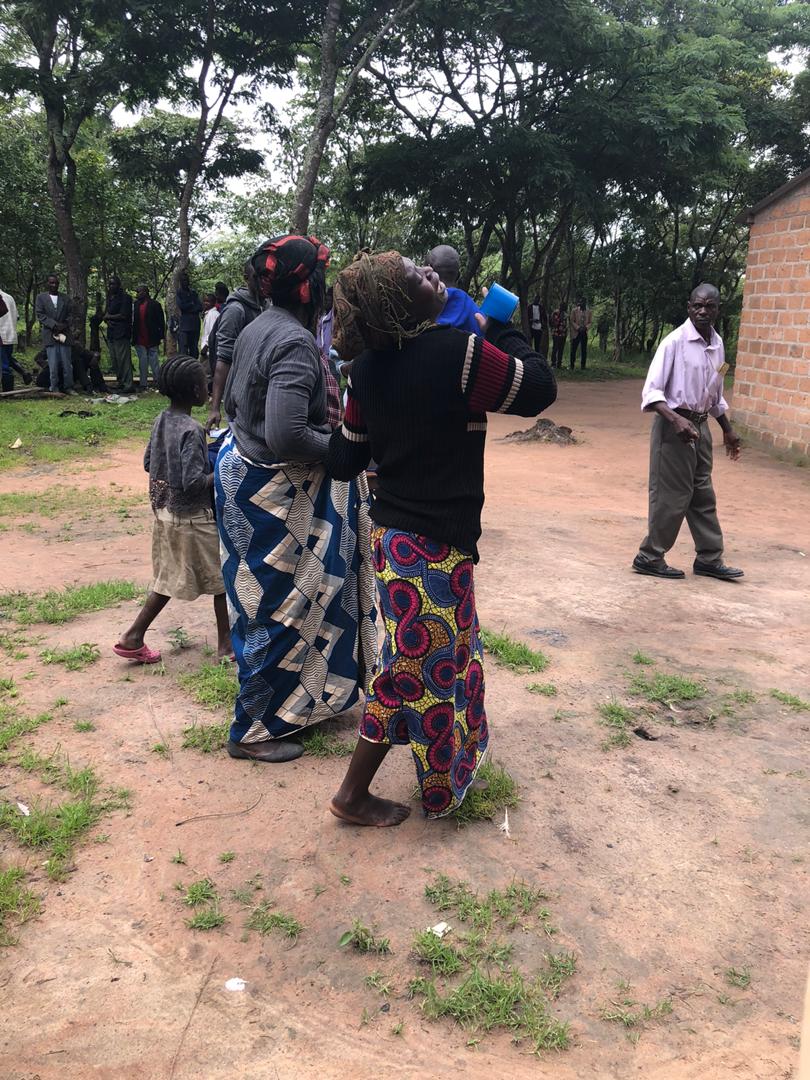

For weeks after, I would see a member of that family and say the thing we all know to say in the wake of a loss. We say, “Mwaculeni” (mwah-choo-lay-nee) which simply means, “You are mourning well.” Note that no one asks, “how’s it going?” as if the mourner should submit a progress report or even be able to articulate the mystery of healing. Just, Mwaculeni: the acknowledgement that you are mourning well – whatever that looks like – whether the tears have dried up or still falling freely. There is a permission granted with that blanket affirmation that that has its own healing effect. To hear the words, “You are doing what you need to do, and you’re doing it well,” might be the kindest thing we could speak to a hurting heart. 

I know my family will gather later this week for a funeral. I don’t know whether they will truly grieve or just have a service. I hope they do both, though I doubt that any women will come into the church and flail themselves onto my mother and aunts and uncles and commence wailing… but I wish they would. For all who mourn, now and in the future, just know that I will always hold (a very African) space for you. 

Thursday, February 13, 2020

love in the rainy season

Starting in mid-November and lasting until early April, it will rain almost every day in Zambia. It doesn’t rain the whole day – just long enough and hard enough to stop work and keep everything mucky. Life in the rainy season is usually chaotic and always messy… It actually makes me think of romance. 

The parallel is probably not obvious to anyone but me, unless they too have tried to nurture a marriage relationship in a small Zambian village. But as Valentine’s Day approaches and I think about all of the challenges that romance has in this context, the grey-green hues in the distance feel like an appropriate backdrop. 


Ten years ago, after our wedding, we returned to Africa in anticipation of continuing the Rom-Com already in progress. Our first home together was a cozy hut with a grass roof. It was perfectly romantic – like something out of an exotic, destination-honeymoon brochure. The idyllic feeling lasted a whole week, until the awkwardness of the paper-thin walls, proximity to neighbors and people knocking on our door in the middle of the night set in. We knew that the rats and snakes were watching us, and eventually learned that our neighbors were too. 


After several months of marriage, when I still wasn’t pregnant, the women of the village confronted me on it. They were appalled that I clearly was not sleeping with my husband and felt like it was their business to set me straight. Putting aside the embarrassment of telling my neighbors just how often we were having sex, I also informed them that it’s possible to have sex and not get pregnant. They weren’t buying it and chose to send me for training. “Show up at the maize shed on Friday at midnight. Bring a chicken.” This was definitely not an optional event, so I went. I returned home the next day and spilled to Jeremy the details of the raucous sex-capade, rambling nonsensical about half clothed grandmothers wielding corncobs while chickens died in the corner. Let’s just say village life has never been boring.

Dampened only slightly by the living conditions and village gossip, we invested in our romance in many ways – carrying on the habits we had developed before we were married. We played cribbage, had candle-light dinners, and talked for hours under the mosquito net.  As far as physical intimacy was concerned though, we resigned ourselves to the awkward sense of exposure and just kept going. Our love apparently has resilient DNA. 


After three long, disapproving years, we made everyone happy and produced a baby, and eventually another. That at least quelled the rumors, but it wasn’t until year seven of marriage when we re-built our house to include proper windows and multiple bedrooms and door locks that we felt like the rainy season of our love-life might actually be coming to an end. 

Nevertheless, while we enjoyed the safety of our new haven, we experienced other storms keeping us apart too. At times when malaria, diarrhea and fatigue have taken over our house, we’ve found ourselves in too much pain to be touched. In times of organizational growth, village drama and government threats, our minds were often too consumed to even think about romance. There has been more than one season when we just could not seem to catch a break. During one such time, things were so stormy that my hair was falling out and the days felt robotic. Out of sheer willpower, we made romantic gestures through heart-shaped pancakes or a sweet note on the mirror, but physical intimacy felt aloof. I looked longingly at Jeremy and asked, “When’s the last time we had sex?” Returning the gaze, he just said: “I can’t remember.” Occasionally, when it rains, it pours.


They say falling in love is easy and staying in love is hard work. Truth. Sex is not the only way to nurture or show romantic love and I’d argue that it’s not even the primary way. It is, however, a powerful unifier, and disembodied romance will usually feel incomplete. For many marriage relationships, sex truly functions as the barometer for the over-all relational climate – a theory we’ve seen proven in more marriages than our own. 

The culture around us states that sex is a man’s right and that it is also a physical necessity akin to needing water or air. Tradition dictates that a woman’s submissiveness goes as far as putting herself in harm’s way – including HIV and black eyes. A sad truth is that we’ve taken multiple women into our home and put others on busses to get them out of extreme situations. And while not every woman is fearing for her life, most have been beaten and few expect fidelity. From the vantage point of the ladies closest to us, even those who are happily married, romantic, non-transactional sex sounds like a fairy tale. 


This is the context in which our own, very public love story is playing out. The same women who taught me how to keep my husband from “wandering” have watched Jeremy honor my body for over ten years. Our closest neighbors may or may not have heard us have sex, but they’ve definitely heard us fight and then watched us make up. They’ve seen us drop hands after a cold word and grab it again after the apology. They’ve watched one of us leave to go sleep at the farm and the next morning kiss on the porch. At times, it’s been shame-inducing to be so on-display – but that vulnerability is also what makes it so productive. 


As Jeremy and I have walked through the uncomfortable exposure of our own relationship we’ve been given a platform to say yes: love making/tending/deepening is never convenient and it’s usually messy; but the green growth that comes from cultivating the soil of connection on which the rain falls is more than worth it. The challenge of love in the rainy season might be very different in our house than it is in the house next door, but we all live it. While the consequences of Malaria vs. infidelity are vastly different, there is solidarity in acknowledging that forces outside of our relationships are actively working to rob us of connection. The desire for love is part of what it means to be human and the brokenness that keeps us apart – both sexually and otherwise – is a universal foe. Our relationship has always looked foreign to our community, but the honesty of our effort to keep love alive has also made it relatable. There’s not a single man or woman around us that doesn’t want to just feel loved


For us, as people of faith, part of communicating the gospel is demonstrating God’s good and redemptive potential for every area of life – including romance. At camps and conferences, with small groups and individuals on our couch, without a hint of mastery or pride, we have shared our own journey. Sex obviously isn’t the only thing we talk about, but given its center-stage, high-stakes role in this community, it ranks right up there on the marriage-topic list. We want people to know that great sex is always possible for God’s people as relationships are restored and as our identity as soulful beings is more deeply understood. Our hope is – through the frank disclosure of our own romance – that we might make relevant “laying down one’s life for a friend… because God first loved us.”

Jeremy and I will probably not be having an overly romantic Valentines holiday. Only a handful of people in a five-hundred-mile radius know that this is supposed to be a lovey-dovey weekend which means we’ll spend time with people and I’ll prepare for school and Jeremy will get filthy at the farm. In short, it’s still rainy season. But I have no doubt that at some point we will pause to look in each other’s eyes and express gratitude to the other for braving the struggles that are as inevitable as mud puddles in February.


Tuesday, July 24, 2018

how I made every woman in a 25 mile radius jealous

We had already been in Zambia for two years when we got married, and as soon as our zam-tastic wedding was over, we were anxious to get back. Being the first foreigners to ever live in the Fimpulu, everything we did was intriguing to our neighbors. They loved to watch the way I braided my hair and washed my dishes and piddled around in my garden and so when we returned to the village as newlyweds, it was no surprise that everyone was waiting to watch and see how we’d "do" marriage.


My neighbors were worried that I’d do it wrong, so they promptly pulled me aside for training. They taught me how to sweep my home and cook his food and make him ***real*** happy.

After a few months of blatant failure in the wife department, my teachers pulled me aside again and told me to step up my game. Their first threat was: “We taught you better than this. Get your act together or we’ll beat you.” Why yes they did. Greater love has no Zam-Mama than this, that she will slap the white off your face if you don’t get your crap together. And their second threat was, “Because if you don’t do it right, he will find someone who does.

In self defense, let me say that "bad wife" is a relative concept. If you were supposed to rise before dawn to sweep the house and scrub your floors and thrice daily cook elaborate meals for your husband while you ate leftovers in the other room, and kneel before him and never look him in the eye... you might be a failure too.


I should also mention the added concern of my elders that we had been married for three whole months and I wasn’t pregnant yet, which meant, clearly, that I was either not doing my marital duty at all, or that I was doing something to hinder conception against my husbands obvious wishes - both of which are cardinal sins.

But the real disappointment, and the reason why the mamas were ready to slap me back to the cold land, was because not only was I failing at my obvious duties, but I was also letting JEREMY do them.

They watched in horror as they saw him sweeping the house at all hours of the day! They saw him stoking the fire and putting pots on it! They saw him scrubbing my underwear! Good heavens woman, have you no shame?!?! One woman asked what kind of juju I was slipping into his porridge to get him to behave like that. Theological underpinnings of the question aside, I explained to that woman and others who were genuinely concerned for our marriage that I had in fact not witched my husband, and that he was doing these things of his own volition. I tried to explained the counter-cultural concept that my husband serves me simply because he loves me.


They still told me he’d leave me within six months. I relayed that message to Jeremy who, being quite offended, retaliated by making out with me on the front porch.

Six months later, Jeremy was still sharing the work load and I still hadn’t born him a child and we were still sleeping with each other and no one else… and all the elders just sort of raised eyebrows and kept watching. Fascinating, they said.

 Two years later, Jeremy hadn’t returned me to my parents or asked for his dowry back and our circle of gawkers grew larger still. I think most women accepted that I wasn’t slipping magical herbs into his porridge, but they still weren’t entirely sure what the X factor in this relationship was. At least I was finally pregnant and giving him his first child, so I wasn’t a complete waste of womanhood.

Turns out the baby was just a whole other realm of radical for my husband. If they thought kissing on the front porch was bold, nothing could prepare them for diaper changes. The reaction to that stunt was so addictive, Jeremy took the show on the road. We had gone to town together and I had entered the market to get some vegetables during which time Jeremy changed Bronwyn’s diaper on the hood of the Land Rover. The next week, there in the market again, I walked across the dusty selling space and noticed an above average number of people staring and pointing at me. (I mean, a handful is normal, a crowd is a little curious.) Finally one of the onlookers approached and all she said was, “You’re the woman who is married to the man who changes diapers!” Umm…  yes! Yes I am! Were you wanting an autograph?


Jeremy’s fame rapidly spread from there. We were hard pressed to go anywhere in a 25 mile radius where we didn’t hear “Jeremy! Jeremy!” being called out by various members of his unofficial fan club. And as for me? I was just “Mrs. Jeremy,” the lucky lady connected to this beast of wonder, who would sweep and cook and change diapers and remain faithful without needing to be bewitched and was still manly enough to build things and drive a tank of a vehicle and kill things… and other such measures of manhood.

manhood - like caring for your infant while slaying cobras. no big deal.

Now jealous though they might be, it's not like any of these ladies are coming after my man. Feelings about Jeremy waver between admiration and sheer terror. He is, after all, a bit of a powerful mystery which keeps most ladies from coming too close. Any woman in the village will still insist on talking to me even if they really have a question for him.

But truly, my husband's acclaim – the stares and pointing and side comments about how lucky I am – these are treasures I store up in my heart. I adore that in a context where we work tirelessly to fit in, that for the handful of ways we actually work to stand out, we do it for love. Jealousy can be healthy if it stirs up motivation to step out and try something new. We feel not at all guilty for the ways this crazy idea of serving your spouse has caught on with a precious handful of men whose end game is happiness and have observed this as a good way to get there. The women on the receiving end know who they have to thank for that novel idea.


I had no clue, really, that I was stepping into something so rare and compelling, making every woman in a 25 mile radius jealous of me, just be simply saying "I DO." And yet, nine years later, as I reflect on the significance of this marriage, I’m thankful all the more for my maven man – the one who turns heads with his flip of pancake and stops traffic with his road side diaper changes. You’re what every woman wants, babe - especially me.


Friday, June 15, 2018

the women we don't know what to do with

When I was a little girl, I attended a church that supported a dozen or so missionaries. These missionary families would visit every so often and when they went up front to share, it was a pretty standard gig. The husband stood on the stage and his wife stood four inches to his left and and two inches behind him. He held the microphone. She wore either a denim jumper or floral skirt, because the 80s were the holiest decade. He finished talking and then half-started to hand her the mic while asking, “do you want to say anything?” And she would giggle and wave her hands ‘no’ and the congregation would giggle right back because shy women are so cute.

I’m sure it happened in other ways too, but this is what I remember. From my 16 years in that church, that was the defining memory I had of missionary couples, and in particular, missionary wives.

A few years later, in college, I was majoring in a foreign language and this thing they called “government” because I liked words and leadership and wanted to dabble in both. The summer after my freshman year, I was invited by my then pastor to attend the Global Leadership Summit. I was the only student invited and one of only a few females. I had no idea why I was there, really. Our church wasn’t small, so, why not invite someone important? During one of our breaks, out in the parking lot as we waited for the rest of our carpool, that pastor turned to me and out of the blue asked, “Do you think you have a speaking gift?”

He might have said more to me after that. I might have responded. I think I was pushing gravel around with my flip flop. I don’t remember. My brain was too busy trying not only to answer the question but also to sort through the ramifications. Do I have a speaking gift? Maybe? So what if I do? Will I ever get to use it? I mean, do women ever get handed the mic? Had I ever seen that happen? How do I develop a gift if I can’t practice it?

Good question. You join the Peace Corps, that’s how.


I spent two years talking, learning another language. Practicing cross-cultural communication. Overcoming fears of rejection and looking stupid in front of people. Trying new things. Making mistakes. Reading and writing and thinking. A lot. I taught things. To men! And no heads exploded! It was incredible!

Fast forward a few years. Newly married, back on the field with my strapping husband. Ready to go be amazing. And I had a complete and utter meltdown. We called another pastor friend and told him I had lost my mind and he said, “Mmm, no, I think you’re just having an identity crisis.”

Is that even a real thing? It must be, because I lived it. I came to realize through time and soul searching that in the transition to wifedom, I had lost myself. Quite suddenly, I wasn’t just a person, I was a missionary wife and I had a very narrow picture of what that meant. I had never really seen any missionary wives do anything other than look cute. The flashbacks from my childhood told me that the husband did all of the important work and she, well, she giggled and said she didn’t want the mic – and everything that implied.

I didn’t even own a jean jumper! What on earth was I doing with myself? The thought of tending the hearth and darning the socks and nourishing my dear husband to strengthen him for daring expeditions into the bush made me feel more purposeless than I’d ever felt.

Thankfully my husband is more of a feminist than I am and he had fallen in love with the Peace Corps/courageous/“of course I can do anything,” version of me, so in his loving leadership, he basically shoved me out the door. 

You are good at organizational management. The school should be yours. No one relates to women like you do. All maternal/child stuff should be yours too. You write better than I do. I feel like you should do all of the newsletters.

He wasn’t asking me if I had some gifts, he was telling me frankly that I did, and that I needed to use them. I said to him what I hadn’t said years earlier at the Leadership Summit: “Do I really get to do that?” And Jeremy’s loving and blunt answer back was simply – “Well, why not?” (His theology is more robust than that, but accountants are also really good at cutting to the chase.)

I stammered to answer his rhetorical question. Well… well… because I thought I was just supposed to wear ill-fitting clothing and cook and stand behind you?


God bless my patient husband.

We figured it out together. He pushed me to write more and speak more and lead more and I began believing that that was ok. Even for a “missionary wife.” For Jeremy, it was never about “man’s work” or “woman’s work,” nor was it some gender-based affirmative action. It was about what needed to get done and who was best gifted for the job. Period.


In God’s goodness to me, we started connecting with churches in our region of Zambia who stretched me all the more. We started getting invited to do a lot of speaking and when we confirmed what exactly they wanted, the response was always, “Both of you. We want both of you. We need to hear from Bethany too. She has something to say to us.”

She has something to say to us.

She has something to say to us.

She has something to say to us.

My soundtrack started changing and each time I stood up to speak, a new picture filled my head. Slowly; repetition will always do its work. Bless you Zambia for giving to me what my childhood memories did not.  


It’s remarkable how the pictures we see – or don’t see – in our youth shape what we think we’re capable of when we are older. In some circles they call it mirroring – the idea that we need to see our future selves in the adults around us. The key principle is this: we don’t become what we don’t see. I didn’t grow up seeing Christian women lead and teach outside of children’s and women’s ministry. My struggle to accept myself in co-ed speaking/teaching/leading roles was a struggle precisely because I had no picture of that in my mind.  

Stepping into water known to have the sharks of disapproval is basically terrifying. I went back to the states this spring for the sole purpose of public speaking; that thing I had never seen a missionary wife do. Every state-trip before this, Jeremy and I had always done our presenting together, and somehow his presence always seemed to make mine more acceptable. Flying solo was a whole other deal. I started out with my knees knocking.

The number of times I was asked, “So why isn’t Jeremy the one doing this?” – approximately 563 million.

The number of times Jeremy was asked, “So why aren’t you the one going?” – approximately 974 billion.

At first I made excuses – a lot of them. Oh, well, he had conferences to run and I had a wedding to attend and this and that and the other (all of which were true,) … But after the 800th time, I borrowed Jeremy’s confidence and script and just said, “Well, why not?”

Why did I come instead of my husband? “Why shouldn’t it have been me?”

The struggle is real. While my experience is not at all universal, I know it’s also not unique. In a hundred subtle ways it gets communicated that missionary wives are background decoration. From the missions articles women aren’t featured in and the mission conferences women aren’t speaking at. From the classes women aren’t leading and the policy they aren’t making. From the gatekeepers who say that wouldn’t be appropriate anyway.

The lack of affirmation translates as condemnation and creates a setting in which every feminine move feels controversial. I have sisters who have accidentally breached boundaries and have been questioned why they feel the need to do this or say that and in those places. And if they answered, “Well, why not?” they were branded “contentious.”  

It took me eight weeks of presenting to really find my voice – to feel like I was joyfully sharing my gift and not timidly auditioning on behalf of women everywhere. The churches along the way that were clearly used to working with women were inspirational. She has something to say to us! The Zambian soundtrack had followed me across the ocean and I stood up a little straighter because of it – only to be taken down a notch when later someone would say, “Wait, they let you speak?!?!”

When a woman feels called to be a wife and mother and has a heart’s desire to serve quietly in the church nursery, this is easy – for everyone. But when a woman feels called to lead or teach or preach, and is actually gifted to do so, it is real work for her to figure out the right spaces to do that. And the question plagues me, and so many others – should it really be hard at all?


Indispensible people with essential gifts are being tragically neglected as whole swaths of the American church can’t seem to figure out what to do with these women. Too often, the action plan is to have them serve children and other women – basically keep them busy – but heaven forbid they might actually have influence!

And all the little girls are taking notice.

they are watching. and who they see matters.

Those girls will grow up, you know, and some will end up following husbands to the far reaches of the earth. This is my story, and my experience is this: global missions is hindered when 50% of the population doesn’t even know what they are good at.

We met a fellow missionary couple some time back and in the course of getting to know them and sharing about our respective ministries, Jeremy and I and the other man all talked about our areas of expertise after which the other woman just stared at us blankly and then finally said, “I don’t know what my expertise is. I guess cooking.” And then she did that shy giggle thing.

Maybe she’s following her heart’s desire. Maybe she’s meeting others’ expectations. Or maybe she just never had an picture of anything else. Now that I’ve been spoiled, all I can think is, Where are all the Jeremys???

Where are the brothers serving as cheerleaders for their sisters saying:

You have a gift of compassion – you should be running this outreach.
You are an amazing teacher – you should lead a co-ed class (because the men need to hear this too.)
You lead brilliantly – take this seat at the table and share your views with us.

Where are all of the men saying on repeat, ‘you have something to say to us’?

We have a job to do, and there is no logic in marginalizing half of our best talent.

I know that there are young girls who are growing up with amazing examples. Those who see women up front every Sunday. Who hear them preach and watch them lead. Who see ladies on boards and serving in a variety of places outside of the nursery and I am so excited for their future. These girls are actively developing their gifts while they are still young because they can see themselves using those gifts when they’re grown. And when they go out? They are going to hit the ground running and will have no need for identity crisis because they’ve known all along what things would look like. And they will gift us with Christ in them, without explanation or hesitation.


And the world will be blessed.