Showing posts with label minimalist living. Show all posts

Monday, March 23, 2020

closed for inventory: the gift of coronavirus

Our one grocery store in the province does this curious thing where every so often it closes for inventory. In the middle of the day. During peak shopping hours. 

In times past when we’ve made a special trip to town, all excited for meat and cheese, and have been greeted by the rejection sign on ShopRight’s door, I’ve observed that it’s impossible in that moment to NOT become “exclusively American” and question why the store doesn’t do this at night and why is there no concern for the inconvenience to customers and who on earth approved this from a profit and loss standpoint? 

Alas. There are no answers. 


Drama aside, the sign telling us to come buy cheese another day is a minor annoyance… but it’s a major reminder. 

Here in Zambia, we finally joined our friends around the globe in “shut down mode.” Your jobs, schools, stores, and gatherings have been closed down for a while now, and as of this weekend, ours are too. I keep thinking about the sign on ShopRight’s door: Closed for Inventory, and I find myself transitioning into a familiar practice. 

You see, this Covid-19 crisis isn’t our first rodeo. Going through the files of my memory, I believe this will be our fourth lockdown experience in 13 years. None of the previous threats were, in retrospect, as deadly as Coronavirus, but their features of marshal law, shortage of food and quarantine resonates with what’s happening globally at this time. And while Corona promises to register much higher on the death scale, our other Zambian experiences have, I think, matched Corona’s psychological impact in terms of not knowing how bad things would get or how long the crisis would last. 

Our lock-down experiences have fallen under the categories of political violence, public health crises and good old-fashioned cultural upheaval (aka, witchcraft,) each ranging in duration from three weeks to three months. During these times, the severity of the threat has ranged from mild concern, to actually lying awake at night waiting for someone to come and kill us. 


What I’ve learned over the course of many shut-downs is that these life-interrupting, life-altering events that make us curse and cry and question why elected officials can’t get their act together, are actually prime opportunities to do a special kind of turning inward. “Closed for Inventory” reminds us that when life as we know it closes down, this is our call to take stock of absolutely everything.

When Cholera demanded our work be suspended, I noticed how unnerved I was and started reflecting over my job: What do I love about my work? Why am I anxious right now doing nothing? Who do I really work for? What about my work makes me tired? Where do I feel energized? When things resume, what do I want to be different? I TOOK STOCK. 

When we ended up spending ALL THE HOURS OF ALL THE DAYS together as a family, and that made me feel stir-crazy, it presented more questions: What are our goals as a family? When our kids are old, what do we want them to remember about this time? Do my kids know how much I love them? How would they know that they are important to me? When things resume, what do we want to be different? WE TOOK STOCK. 

When our emergency evacuation insurers told us we were too remote and they couldn’t get us out, even if we were in danger, I felt vulnerable in a totally new way. As I noticed the cortisol flooding my system over the idea of being stranded without a safety net, I began to ask questions: Are we being smart? Which ranks higher: my desire to serve or my desire to be safe?  If I get really sick, am I actually afraid of dying? I wrestled with what my responses exposed in my worldview concerning life, death and purpose and pondered the false security that things like insurance tend to provide. I came to a place of acceptance regarding my own sense of control as well as my mortality. I got real meta, in a way that mattered. I TOOK STOCK. 


When “stuff” was hard to get (INCLUDING TOILET PAPER, YA’LL – WE SEE YOU) and I noticed my heart racing when certain items disappeared from shelves, we evaluated our commitments to minimalism and radical contentment. In times of greatest resource-insecurity, we made conscious decisions to downsize. Yes, downsize. We simplified our meal plans and wardrobes and reduced clutter in every space in the house. This sounds counter-intuitive when most people globally are currently hoarding, but we found it incredibly liberating. When stuff was not available in shops, we asked the question, Can we manage if certain items never return? Is this a need, want or addiction? Would changing our expectations actually serve our minimalist goals? When our grocery store burned to the ground (next one being roughly 400 miles away) we said, well then, this will be different. And we pivoted. The loss of material security does not mean the end of life, it means the end of life as we know itIn times of crisis, life is different, but not over and paying attention to what we want/crave/miss when its gone is informative. WE TOOK STOCK. 

I need to confess; this healthy introspection didn’t happen instinctively the first time around. When chaos erupted and big men with big guns started patrolling and everything was canceled, oh we freaked out – like normal people. The default reaction in human beings when faced with danger and insecurity is that our limbic-brain engages and we go into fight or flight response. “Panic mode” is the factory setting, despite not being very productive. I think for Jeremy and me, we were able to shift from panic to productivity simply because, even though we were wrapped up in our first crisis, it wasn’t the first crisis for the people around us. Instead of panic and worry, our neighbors immediately launched into story mode, and it was fascinating. They told us about Independence in ‘64 and whatever outbreak in ‘80 something and the riots in the early 2000's. They told us about how they learned to greet each other by tapping feet and bumping elbows. They told us about changes in local economy and food and what they did and how they felt about it then and now. They narrated from the past what we were seeing in the present and then declared like bosses, Twalikwanisha. We managed. 


Something about their crisis management plan made us both curious and jealous. Their obvious mastery over that default, limbic, panic-setting was winsome and compelling, and it was probably the thing that made me ask the first of all the introspective questions. Through their measured response, I was confronted with a significant contrast: People are throwing rocks and stuff is literally on fire and I’m terrified of anyone who breathes on me and it’s not like the people around me aren’t living with this chaos too… but I’m watching them gracefully change course… and it’s speaking to me that I’ve got some work to do. 

And I did. And as a family, we did. The key to thorough inventory is to pay attention to the felt emotions in your body and observe them with curiosity. When you feel anxiety, fear, anger, panic – any form of disturbance whatsoever – there is a question begging to be asked. And when a question is asked and answered, new awareness and therefore new emotions may arise that need to be observed and engaged, and that process needs to be repeated until you come to a place of ultimate inquiry: Is the way I’m coping with my situation actually serving me, and if not, what is in my power to change?


Now, as Corona presents yet another forced opportunity to stop and notice what’s bubbling to the surface and make a conscious decision about how to respond, I’m oddly grateful. Just because I’ve done this a few times doesn’t mean I’ve reached some sort of crisis-management nirvana. There’s a lot I’m not worried about because, been there, done that. But I’ve still got my stuff, obviously, and Covid-19 is presenting new circumstances and begging new questions.

I’ll just be transparent and share that I'm leaning in, and it’s already uncomfortable. Unlike previous crises which were isolated to Zambia, the fact that America is struggling at the same time means our funding has taken a significant hit and I’ve been feeling the growing pit in my stomach and a racing mind keeping me awake at 2am. As much as I’d rather mindlessly scroll Instagram right now, I now need to stay present to those feelings and ask, If funds continue to drop, where is the fear in that coming from? What does it mean to “have your needs met?” If you have to pick and choose, what populations or programs matter most? Can Fimpulu live with a Choshen scale-back? Who are you trusting for your provision? I NEED TO TAKE STOCK. 

From lived experience, I know that this is important… and the only way to do crisis well. At least I know that if I press into the discomfort, the fruit of introspection will last long after the crisis is over. This is the gift of Coronavirus.


The sign has been hung. This is our time. All of us. To do our work and take stock. Don’t waste it. 

Wednesday, February 3, 2016

the idolatry of minimalism

Spawned by a 1970’s art history movement, minimalism became the choice descriptor for simple art and design. It kept a low profile for several decades until something (the mystical powers of the mommy bloggers) in America caused the term to broaden its meaning beyond art and into every day life. Suddenly, the internet was giving us all the directions on how to downsize our wardrobes and discard nick-nacks and shrink paper piles and everything in between. Minimalism spawned whole new species a la minimalist parenting and minimalist cooking and minimalist hairstyling – and bit by bit, the fad became wisdom and we all realized that fat and cluttered and complicated were not actually recipes for happiness.

I bought into the minimalist philosophy long before I knew it was cool, long before Becoming Minimalist started telling me to do all the things I was already doing. My first house after college was a tried and true minimalist hut. The entire structure was made of earth. Good, clean dirt and grass and water and clay. I especially loved my dirt floor – I could drain my pasta water right next to the fire which was also dropping embers onto the floor of my kitchen-living-dining room. It was infested with rats and bats, and I loved everything about it. (The Peace Corps tends to attract not-high-maintenance people.) I had no furniture save a bed, a table with no chairs (because the village carpenter was clearly not looking for money) and a rough hewn shelf. And it was all I needed.

Not what most Americans think of when they hear "starter home," but I loved it.
Also, unrelated side note: baby face Aggie on my left there is graduating from high school this year. *tear*
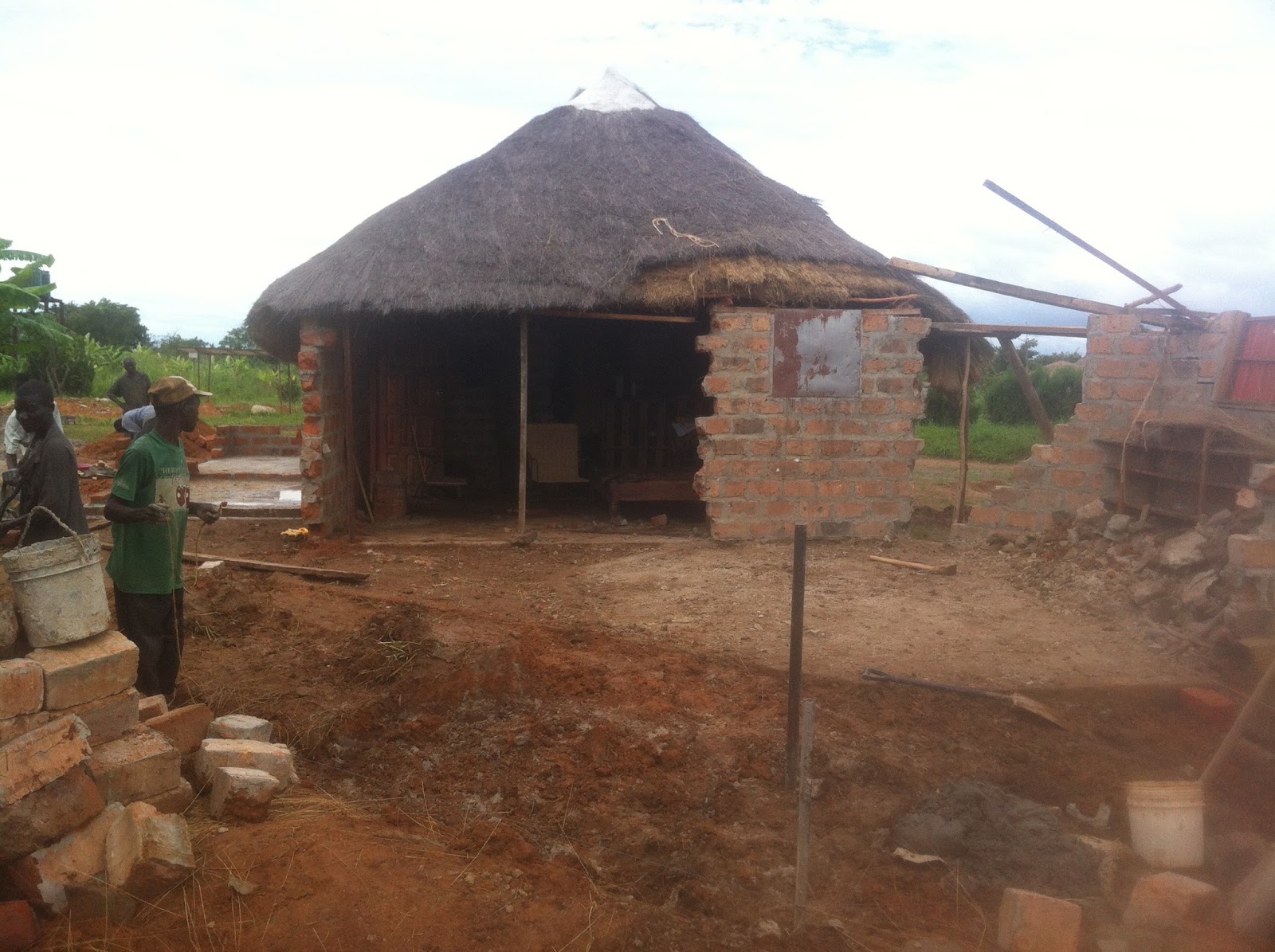
Marriage and children pushed my minimalism boundaries a bit. Jeremy insisted on a not-dirt floor. I'm a good wife, so I conceded. When Bronwyn came along and started sleeping with us and none of the spaces in the house was big enough to fit our new bed, change was necessary. Bit by bit, we've pushed walls around and added a few amenities, taking a “step up” every year or so… and every time, I’ve felt super guilty about it. It’s like my inner minimalist is being asked to commit perennial felonies and I hate it.

I still find the simplicity of it stunning

the bungalow/rondoval/yert we custom made to fit our co-sleeping bed 

this is how we reno: Jeremy with power tools on top of a chair on top of a chair on top of
a table being stabilized by three boys pretending they are Jet Li. Call us for bookings, HGTV.

Principled is my middle name, and my minimalist principles are chiseled on stone tablets. One of the principles of our work is that we live with and like those around us. We believe strongly in the power of integration for effective communication and we’ve seen the fruit born of such an ideology. Rich people living amongst the poor must acknowledge the baggage they carry unless they want their dialogue to sound like this:

 “Hello! My name is $$$. I’m so happy to be here for the sake of $$$. Would you like to partner with us on $$$? Maybe we can get together and talk about $$$? Ok, well sounds like $$$ would be a good idea? Let’s chat more about $$$. Thanks! Bye… $$$$!”

True story: I have actually had people greet me (outside of Fimpulu, thankfully,) with the words, “Hello, Dollars!” Its crazy unsettling and it totally confirms the need to establish a different name lest we adopt $$$ as the super-inappropriate default.

Hard work pays off, and I’ll be purple duck if living in the bush doesn’t qualify as hard work. After several years, people commented on it – a lot – to us and to others. “Hey, there are these white people in our village and they live in just a house like ours!”

I’ve heard that no less than a dozen times, and I always pat myself on the back a little for it.

happy little homesteaders
Equally strong as our convictions around simple integration are our convictions around the science and theology of minimalism. Studies have proven that less clutter correlates with greater happiness and verily verily, we can attest that throwing junk away feels good. Furthermore, Jeremy and I are both proper Sunday School graduates and we know this to be true: Don’t store up your treasures on earth where moth and rust destroy. Have less crap, says the Teacher. And all God’s people shouted Amen.

But life is a forceful tutor. My baby got malaria. And then she got it again, just as Jeremy and I had too, and this happened over and over until our family malaria count is somewhere around 20 and we stopped counting because that’s silly. Our roof started to slowly dust away to nothing and we unloaded 10 cans of insecticide to assassinate the beetles eating it, and I don’t even want to think about the brain cells we killed with that choice. We’ve all had weird skin ailments and are far too comfortable with conversations about diarrhea. We had a season of hairy spider infestation too. Our newest thing is that we now have an indoor “water feature,” a tranquil waterfall flowing down the side of our kitchen wall collecting in a small pond that touches every square inch of our living room. So vogue.

One afternoon, I watched Bronwyn skype with Grandma, naked and fevered, lying on the floor and looking painfully pitiful. To say that I felt like a bad mom would be an understatement. That same day, Jeremy read me an article from a study in Uganda claiming that tin roofs, when compared with grass, saw a 50% reduction in the incidence of malaria. The wise husband started asking me if we should make some changes and I said “NOOOOOo!” faster than he could say “MALARIA.” My heels are dug in pretty deep in this Zam-mud. I dogmatically recited our mantra. "We live simply. As do our neighbors. If they can do this, so can we. We do not need more comforts than what we have. We. Do. Not.”

But I slept on Jeremy’s question all the same. For many nights... and mornings, mopping up the lake in the livingroom and dumping the mosquitos out of our little night-light-bug-sucker thingy and swabbing anti-fungal goo onto Leonie’s face and killing all the spiders of the world for Bronwyn.

The staunch conviction that we must live JUST like our neighbors started to waver a bit as I was rattled by my lack of hospitality towards my own children.

Hey Guilt Hey! Our minimalist principles are hard and fast, and so by conceding to change, it felt like we were wimping out, throwing in the towel, and embracing that which we’re most adamantly against. In our case, however, “go big or go home” is more than a tagline. It’s a mandate linked to real possibilities and real consequences. We understand that if we don’t take care of our family, we’ll have to opt out of this gig all together and it would behoove us to make sure that doesn’t happen. Alas, the hubby is right.

We’ve emphasized how simply we live to everyone who has tracked with our work. It’s kind of been a thing we may have bragged shared about more than once. (oh hey extra layer of guilt). But we’re going to have to change our story. Because we done gone ripped our roof off. We sure did. We tore some walls down and we we have begun operation hospitality: the effort to turn our house into a home. Dear everyone, the goals have changed.


Once upon a time, the goal was to live as simply as possible, idolizing minimalism and embracing an almost-ascetic brand of discomfort. I judged hard-core anyone who commented that they couldn't live like we do because truth is, yes you can - we are not special. But. Just because one can doesn't mean that one has to or that one should, and I've spent near on a decade parsing this distinction out. There’s a difference between seeking comforts because of a materialistic spirit and/or an immature avoidance of hard things... and seeking to not be so sickly and tired all the time. 

The goal now, therefore, is not to live comfortably, but to live comfortably enough. To have enough space that we can think and breathe without thinking and breathing on top of one another. To have enough of the household amenities that we aren’t stressing our bodies or our time to complete basic tasks. To have enough distance from the outside that we don’t feel like we are at constant war with the environs. To have enough aesthetic beauty to lift our spirits when needed. To have enough rooms and bed space so that the parents don't have to sleep with all of the kids forever and ever amen!

Enough.

Not all the comforts, not more comfort for more comfort’s sake, but enough.

Enough is defined by a matrix of culture and age and personality and gumption and grace and when it comes to "how much is enough," one size fits all is inadequate and lame. We have had to draw the lines in our own (literal) sand, and we've done so prayerfully and with great forethought. 

There have been seasons when we've embraced less for less’ sake, and we’ve hurt ourselves. We stand actions of starting off in the village sans fanfare. We acknowledge that it is because of our early choices that today we are not dollar signs, but rather friends, neighbors, helpers, and co-workers. By the same token, it is because of our history and friendship that at this stage in the game no one gives a rat’s rear whether we change our roof or add some square footage. Truly, they don’t care. Because after nine plus years, surprise, surprise, the intrigue is gone, and people are genuinely happy that we are doing something nice for our family. (Confession: because guilt is a twisted friend, I compulsively polled people on this to make sure we weren’t making a huge mistake and that our friends would not covetously despise us forever. Weirdo.) But when we received the equivalent of the Papal blessing from the neighbor folk and the grass came flying off the roof, we knew it was ok.


When we were fresh and pink and smelled like we had just stepped out of Wegmans, the people of the village were watching to see what we were all about. Now years later, we have children, and THEY are the ones watching to see what we are all about. As a principled mother, I want them to see frugality not futility. I want them to see moderation, not masochism. There’s a way to not bow to the god of mammon and still care for your body, mind and soul… and there’s a way to responsibly spend the money to do so.

Today I stood in the original house, the one the size of my parent’s bathroom, stroking the walls and tearing up, saying to Jeremy how I would miss that precious structure; the one in which he carried me over the threshold, to which we brought home our first child, where we made a name for ourselves in more ways than one.

"We’ve come far," he said. "And we’ll go farther still," and back to demo he went. 


Sunday, December 6, 2015

individualist parenting in a communal culture (how to raise hybrid children without forfeiting your soul… or your possessions)

I experience my fair share of discomfort in the realm communal living. Like when I can’t charge my phone because the power has been drained charging everyone else’s. Or when the toy room smells like pee from all the leaky butts that have sat in there on any given day. Or when I have to “odi?” (“knock, knock”) my own pit latrine to make sure its empty. Or when I have to reclaim my personal belongings that were “borrowed” off of my clothes line. Uh, yeah... It goes over real well. Kind of like using sand paper as a slip and slide, which is to say, sometimes, I feel the rub.

I love village life. I really do. But more often than I’d like to admit, my old life as a purebred individualist knocks heads with my present life in a collective culture. If I were living in the country of my roots, I’d probably be one of those people with a fence, or at least a hedge. I’d have spotless floors and breakable objects on display shelves. My neighbors and I would maintain a certain respectful distance, ringing doorbells and asking favors with courteous scarcity.

Here? No dice. Village life simply imposes a different ethic – neither more right, nor more wrong, but certainly different. What’s yours is mine and what’s mine is yours and you are there for me and I am there for you all the time… ALL. THE. TIME. Perhaps it’s the perpetual commonality that gets to me. No one action is particularly troublesome, but little things add up and I start day-dreaming about vacationing on a deserted island. By myself.

Don't be misled; Bana Nkandu has an American flag as her front door,
but there is otherwise nothing else "American" about this village
The real threat of discomfort and the irritation is not that I have to clean up after kids who are not my own, or say “yes” more times than I’d like… but that I start resenting doing so. Chagrin is the pill we ex-pats have learned to swallow whole… but too easily, too often, resentment presents itself as the symptom of an overdose. Resentment makes our brows furrow and our hearts harden. It pushes back instead of embracing fully. It tunes our mind into all things negative and refuses to see beauty and goodness. And the truth of the matter is, (because Jesus jukes are often true),  resentment isn’t exactly Christ-like.

I’ve had years to work through all of this, and both Jeremy and I have made some changes to the way we approach village life so as to protect our hearts from the this particular brand of disdain. We’ve set certain boundaries on our how we give, certain parameters on our time and the intensity of our relationships, and we’ve intentionally chosen, in advance, to “let go” of about a thousand little things. We still give ourselves a fair amount of cultural latitude when we recognize that familiar curling in our bellies when someone makes a request (which always sounds more like a demand), that we just aren’t willing to meet. No matter how “Bemba” we have become, we aren’t lying to ourselves and pretending that we aren’t still a little bit (a lot bit) American. For the sake of our emotional health, we’ve learned to accept that.

Motherhood, however, has introduced a new realm of potential conflict as I seek to balance the communal/individualist interactions not only for myself, but for my girls as well. Sweet and innocent souls, they are like blank slates and I so deeply want to see them written on with the beautiful poetry that is the blending of cultures. Particularly in Bronwyn, (as she’s the one who does more than eat, sleep and poop), I see communal characteristics in her that make me beam proud.

I love my mini-me and I'm crazy proud of her
She firmly believes that anyone should be able to eat the food out of our house. I preemptively make her two cups of chocolate milk even if she’s still the only one in the room. She’s constantly dragging kids into the house and shoving toys in their hands. She writes my shopping list, “Timo needs this, and Beauty needs that…” Bless her heart.

She’s so generous and sharing and kind, I’m so blessed by her… and yet, it stresses me out. I’m not oblivious to the downsides to all this too. For example, Leonie has ZERO hand-me-down board books because the neighbor kids have totally thrashed every single one. I just threw out a stack of fully colored-in coloring books that artistically filled by everyone in the village – except Bronwyn. Her markers have all been run dry and the cars are now all missing wheels and we will never know who took the round green apple from her shape-teaching picnic basket. I’ve had to remove the carpets I bought for the girls to sit on, exposing the cold, hard concrete because I can’t handle the constant pee smell any more. Any of the toys that made any kind of noise are either dead, busted or missing parts due to CONSTANT-INCESSANT-COMPULSIVE use.

When another irreplaceable item bites the dust, I can’t lie, I’m a little sad. Because Bronwyn is three, and therefore kind of flighty, she does move on quickly, despite her disappointment. But I’ve started to recognize the pattern of destruction and loss and I feel the need to protect her from that.

No offense to my neighbor kids – I clearly adore them, and they are not all destruct-o-bots. But this is what happens when 60 kids a day play with a set of toys which are new and unfamiliar; playing with them in ways that they would play with their nature-based, indestructible, renewable toys. In other words, they play long, and hard and without a real sense of care or preservation, because this is what they are used to. 

all village babies are nature babies, and its pretty hard to break nature
I suppose we could cut our girls off from all toys... but something inside of us as parents (and all the grandparents) take great joy in giving these things, and we want to teach them the love language of receiving and giving gifts. Therefore, for the girls’ sake, (and to be honest, probably a little of mine) we’ve set some boundaries specifically for our kids to protect from what we believe would otherwise breed resentment.

·      * I separate out the girls' new/special toys and keep them in their bedroom for a while before putting them into circulation.
·      * I limit the number of kids that are allowed into the toy room at a given time. (That number is upwards of 20, but it’s a limit nonetheless.)
·      * I only give the renewable food items (Zam-bought) to the kids as snacks.
·      * I’ve kept the front room of our house (the kid room) simple and as durable as possible.
·      * I help Bronwyn in particular weigh the consequences of certain "communal" choices, and let her make the decision.

I don’t want to discourage the girls from sharing. I don’t want them to be suspicious of their friends as ‘kids who break things’. I don’t want them to be stingy or closed-handed or selfish or greedy; these are the characteristics of staunch-individualism that Jeremy and I have worked hard to shed from our own character, and we want better for our kids.

At the same time, I feel a sense of loss when the book gets ripped in half before it was ever read, when the gift from Grandma was enjoyed for a mere day before going hoarse with overuse, when certain little things leave the house and disappear into the void that is THE BUSH.

aww, little B; and yep, that lift the flap book has no flaps... or front cover...
I’ve waded through miles and miles of mucky guilt over this particular parenting ethic. I know full well that separation in any form creates a differentiation, and differentiation creates relational distance. In other words, by encouraging her to set boundaries with her friends, to not share all the things, all the time, I’m telling her to be different in a way that will remove her from the inner circle  at least a little bit.

My heart is wringing itself even as I share this because I hate that sentiment so very much. I don’t want to separate her – I want to immerse her, and it breaks me that it can’t just be easy to give her all the conflicting things in life.

G&G put a lot of love into this and I want it to last
However, in nine years of hard mistakes, I’ve learned that resentment comes easy when you feel like people just love you for your stuff – when you feel used and taken advantage of. In the fuzzy way that is the mash up of two cultures, my parenting wish is to help the girls create healthy boundaries that will help them love their friends more, neutralizing the breeding ground of bitterness and irritation.

playground = neutral ground. play hard, play long, play free. (also, Bronwyn is a goof)
We’ve known missionary families who have left the country because their children could not handle the relational dynamic of being the kids who were loved just for their toys. Their stuff got busted, and their trust did too – something I don’t want for my girls and our family.

Today is Saint Nick's Day, the day we do "Christmas" presents as a family, and the “stuff” question is on our minds once again. We are navigating the waters the best we know how.

The best we know how.

I should needle point that on a pillow for Bronwyn to sleep on, and maybe she’ll grow up knowing how hard we’ve tried to help her love others, share openly, and care for herself well.


Happy St. Nick's Day! 
What about you? Do you struggle with individualism in your own culture/community?

Saturday, July 19, 2014

living simple, living small

I don’t function well amidst clutter. I can’t work. I can’t think. I can’t sleep – not if there are piles of things laying where they don’t belong. Sometime post-college and after I started living alone, ordering my surroundings became a hobby. I’d arrange and rearrange my few belongings and all of life would be put on pause if something disrupted my sense of order.

After getting married, Jeremy and I had to work out our “stuff” related issues. While Jeremy is not nearly as OCD as I am, he still values an uncluttered life, particularly given our limited square footage.

While living simply and living small is par for the course in rural Zambia, we've noticed that many of our American friends struggle with the desire to downsize. Hip designers have rebranded small homes as “space efficient dwellings” and Pinterest has taught us a thousand new ways to creatively store all our crap. There are clearly ways to shrink your life, and yet... THE STUFF. The real struggle doesn’t seem to be in the floor plan or in finding clever storage cubbies. The battle for simple and the battle for small is waged primarily at point of purchase.

This is something Jeremy and I learned early on, cohabitating inside a petit abode. With every pending purchase we stopped to ask, “where are we going to put it?” We knew that if we were going to live unencumbered by junk (or treasure) we had to be diligent on this point. And for the most part, it has not been that hard – especially since, truth be told, there isn’t that much stuff to buy in the Luapula region.

We are able to contrast our Zambia life, however, with the  consumerist culture that so totally dominates America. Even in the few weeks of sojourning in America every year or so, we absolutely feel the marketing pressure coming from every direction telling us to buy more stuff and put it in a suitcase and haul it back to our too-small house in the bush. Every blessed time we have traveled to the states we have said, on the front end, “I don’t think we’ll have much to carry back this time…” And then we end up stuffing our luggage to max capacity. Why? Because America is flashy and we are weak and the struggle is real.I may or may not have lugged 50 lbs of Wegmans across the ocean in May. 

Staging our own form of intervention, we've given extended thought as to how to conquer America, how to stick to our guns, to keep living simply, and to keep living small. We're developing habits now that we hope will serve us well, particularly if we ever move our of Zambia and into a first world country. To share with you all some of what we've come up with, I’ve compiled here a list of ideas and tactics that we use somewhat in Zambia, but particularly in America, to combat the compulsion to buy stuff and expand storage and clutter our lives.


14 habits to develop towards simple and small living

1. Develop the mental discipline of NOT comparing. Size, quantity, expense, niceness. None of it. Comparison is the gateway drug to both discontentment and justification, both of which inevitably result in shopping therapy.

2. Turn off the TV and put the magazines down. It is near impossible to look at pictures of beautiful people and all their beautiful things without lusting after it all a little bit.

3. Change the question from, “Can I afford it?” to “Can I live without it?” The answer to the first question keeps your bank account in check, but the second keeps crap out of your closet.

the living room. that's all she wrote.

4. Make penny pinching a game. An albeit weird game, see how little you can possibly spend this quarter and then try to beat your record next quarter. Every time you pass up a sale or go without the upgrade you get to squeal, “I’m winning!”

5. Don’t celebrate how much you saved – celebrate how much you didn’t spend period. Similar to number 4, but with a twist. Many bargain shoppers love to purchase items that are on sale just for the thrill of the 50% off, not because they needed that item. Garage sale-ing is perfect for finding a very specific item but is clutter suicide when you’re just hunting deals.

6. Budget like a fiend. If all the pennies are “locked” into another category/account/budget line item, they just aren’t available for unnecessary purchases. Revisit the flexible areas of the budget often to see what else you can trim down and throw into savings – or generous giving which brings me to my next point:

the play area.

7. Find excessive amounts of joy in giving money away. When you commit to tithing a certain amount and giving regularly to charity or missions or child sponsorship, that money is less likely to be used on stuff for the basement. Establish biblical convictions about tithing and stretch your limits. Consider increasing your giving amounts each year. Don’t know where to give? Choshen Farm is a FANTASTIC option.

8. Engage the one-in-one-out rule in as many areas of your life. Fine, buy the new dress, but another one has to leave the closet before this one comes in.

9. Set time limits on unused items. Haven’t golfed in 5 years? To Craigs List the clubs shall go.

10. Seize the moment. That irrational/angry moment when you look around and feel like you are a candidate for hoarders? That’s when you need to go on a rampage, throwing out everything you don’t use without thinking twice about what ends up in the trash or donate bin.

the homestead at a glance.

11. Find accountability amongst like minded friends. Talk about your shopping habits and confess your materialism. Play the penny pincher game with your besties and surround yourself with people who are a positive influence – not a stumbling block – in this area.

12. Determine in advance which will be your bulky or splurge items. We built an entire separate building to house our king sized bed so that we could bed share under the same mosquito net. No qualms there because it was intentional and right for our family.

13. Hand write the values/priorities/mantras that will keep you in check.  “I value storing up my treasures in heaven,” “no new shoes until we are debt free,” “where moth and rust will not destroy…” Write it, post it, ponder it often. And as a way of creating a less materialistic vision for your life… (see 14)

14. Spend more time in the Bible letting those thoughts dominate your own. When you are compelled to mission, sacrifice and God’s glory, everything on Amazon just looks so much less attractive.

the culinary corner.


What about you? What tips can you share for cutting down on the clutter and living simply and small?